Wednesday, November 25, 2009

Window

I’ve never had to dart across the street under fire, but I’ve seen people do it on TV. The trick is to crouch behind something thick and bullet-proof—a shot-up car, for example, or a buxom young blonde. You squat there, looking intense, then poke your head out like an anxious groundhog. When the coast is clear, you make a break for it, charging across the street before the bastards get a chance to reload. That’s the basic set-up, though you can accessorize with a sawed-off shotgun or a steel briefcase full of money if you prefer. QKNW6BDWDSBP

Apart from the briefcase full of money, that scenario is a lot like sailing around New Zealand. Before rounding East Cape, we crouched in Mt. Maunganui, feeling nervous and forlorn. Every morning, Peter checked the weather. “GALE WARNING IN EFFECT,” the friendly lady informed us. “WINDS SOUTHWEST 20 KNOTS, RISING TO 40 KNOTS IN THE AFTERNOON. MODERATELY ROUGH SEAS BECOMING VERY ROUGH IN THE AFTERNOON. IF YOU SAIL TODAY, YOU’LL DROWN, WHICH IS AN EXTREMELY PAINFUL WAY TO DIE. THANK YOU FOR USING NEW ZEALAND MET SERVICES.”

“Maybe we should wait a day,” Peter would suggest. “That Turkish place makes an awfully good falafel.”

Then we’d go into town and stuff ourselves with chickpeas and chili sauce, and try to forget the Apocalypse that was being unleashed to the east of us.

And then, last Friday, we got our weather window. “WINDS NORTHWEST FIFTEEN TO TWENTY KNOTS,” the friendly lady informed us. “CHANGING TO WEST TWENTY KNOTS THIS EVENING. SEAS CALM. IF YOU SAIL TODAY YOU WON’T DROWN, THOUGH YOUR BABY MIGHT THROW UP ON YOU IN A FOLLOWING SEA.”

“Let’s do it!” Peter announced. “Get that anchor up and roll out the towels. We’re headed to Gisborne!”

And despite the weather lady’s friendly optimism, we took every precaution. The first thing we did was move three hundred pounds of chain out of the bow, and shift it into the bilge. This, we hoped, would help Sereia to sail through waves, rather than just squat on them like a petulant toad. Then, I prepared to be demolished by seasickness. I made a pile of ham sandwiches, a big pot of pork and beans, and baked several loaves of bread.

As we steamed out of Tauranga harbour, we clutched our bread at the ready. There’s a statue of Tangaroa there, the Maori god of the sea. As you leave port, you say a little prayer and toss him some bread—or else. In 1950, the crew of the Ranui got a little drunk and chucked some empty beer bottles at Tangaroa, instead of his favorite food. Their boat smashed on the rocks, and twenty-two sailors were killed. Sereia wasn’t about to make the same mistake.


Peter and Matt raised the sails and headed out to sea. Silas sat down below, happily playing with Legos in our cabin. And I lay down my head and prepared to die. It’s only forty-eight hours, I reasoned. A person can throw up for two days and survive. How bad can it be?

And it wasn’t so bad, actually. Like so many worries and fears, the anticipation was worse than the trip. Our sail round East Cape, in fact, was fabulous.

First, we sailed North-Northeast, directly for White Island. White Island is an active volcano which last erupted in 2000, shooting boulders the size of Buicks into the surrounding sea. We approached it at dusk, when the sun set its slopes in sharp relief. Pale puffs of smoke shot above the cliffs, the crater’s rim curling like the claws of a crab.


Enraptured, I took my hands off the wheel. And promptly jibed the boat.

“Sorry sorry sorry!” I hollered, yanking us back on course. Jibing the boat by accident is a major faux pas in the sailing world, sort of like throwing up on yourself at an afternoon tea party. But Peter barely noticed. Because right then, a seagull the size of a Labrador retriever swooped past.

“Holy shit, was that an albatross?” Peter ran to the stern, pointing like a maniac. The bird, now headed toward the volcano, had an obscenely wide wingspan. You would have a difficult time parking this bird in a single-car garage.

We left White Island astern, its smoke signals floating in the gathering gloom. That night, as we approached East Cape, the wind kicked up and we sailed all night, charging toward the easternmost point of New Zealand in a rush of waves and foam.

Because I am a selfish troll, I claimed the last night watch, and sailed into the dawn on the morning of November 21st. I saw the sky blushing pink behind the Cape, and tried very hard to feel awe-struck at the thought that I was the first human being to see the morning. But irritating, rational thoughts kept invading my head, like the notion that the Earth is a sphere, and time zones are arbitrary lines drawn on a map. So I just sat there, shut up, and tried not to jibe the boat.

The island off the coast of East Cape, by the way, is called East Island, which almost makes a complete set: North Island, South Island, and East Island. Those early New Zealanders had a marvelous knack for metaphor.

Late that morning, I was sacked out in the main cabin, when Peter gently tugged my shoulder. “Orca,” he whispered. “A whole family of them. Come and see.”


I dragged myself on deck, and there they were. At first, they looked like dolphins, just fins breaking the surface of the water. Then they swam right at the boat, peeking at our propeller and rising to the surface to see who we were. A family of orca: mama, papa and a little baby.
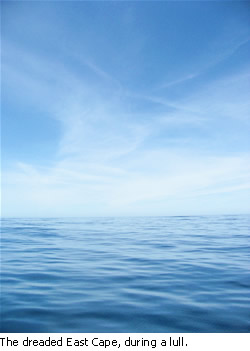
We’d picked our weather window carefully, and now we were here, at the dreaded East Cape. The sea was glassy, the weather calm. And instead of fighting for our lives, we could feed Free Willy from the palms of our hands.

But the problem with weather windows is that they come to a close. Sooner or later, the bastard reloads. We saw White Island at sunset, we spied the first dawn, and we frolicked with whales. And now we had a quandary. We could keep heading south toward Gisborne, arriving in the middle of the night. Or we could tuck into Tolaga Bay for the night and have a good sleep, then make for Gisborne in the morning. We opted for sleep, and the next day the window was closed.

It wasn’t a gale, and there weren’t any mountainous seas. It was just twenty-five knots, on the nose, and six-foot swells, all the way to Gisborne. Sereia leapt and crashed, Silas hollered, and Peter tried to distract him with wolf noises below. I stayed on deck, dripping with spray, and tried to keep down my breakfast.

As for Matt, he just steered. He loved it. For about eight hours—though I admit I lost count—he wrestled that helm on course, steering us back and forth through angry seas as we tacked our way south to Gisborne. He refused to give up the wheel, helming in a 25-knot headwind , wearing nothing but shorts and a windbreaker. It was all we could do to keep handing him granola bars, watching anxiously for signs of hypothermia.


Then, at seven o’clock in the evening, we made it. It took us ten hours to travel twenty-five miles, but we tucked into Gisborne marina, just steps from the sportsfishing club, where bacon double-cheeseburgers and cold draft beer could be had for the asking.

“WHY are you sailing around New Zealand?” people ask us, and sometimes I have the same question myself. We’ve been cold and miserable. We shower infrequently, there’s mildew on the ceiling, and sometimes we wake up in the night, afraid.

But then, the window opens. We sail through a wilderness that most people can’t begin to imagine. The outlines are crisper, the colors are finer for the fear we surmounted to get here.

And I'll make sure we keep extra bread on board, and every few days, we'll toss off a slice for Tangaroa.

Wednesday, November 18, 2009

Renewable Energy

When you start your day coated in vomit, you know things can only get better. This was a comforting thought for me, as I pushed aside a foul-smelling baby and heaved mightily into a red plastic bucket.

“Oooooh,” said Silas, impressed at the volume.

“Sit back and observe, youngster,” I told him. “You’re learning from a pro.”

“Da DA!” Silas crowed, then lunged at the bucket. “Di di di di di !” He flapped his hands, hoping to splash in the nice warm sauce his mother had made. When I yanked it away, he looked at me inquisitively. Where’s my rubber ducky? he seemed to be asking. Where’s my toy boat?

“Cool it, kid,” I told him. “It’s five o’clock in the morning. We don’t splash in our vomit ‘till at least lunchtime.” At the thought of lunch, I heaved again, then handed the bucket up to the cockpit so I could set about cleaning up the mess.

Sereia can be a tough boat to sail on. Though the winds never got above twenty knots on this last leg to Tauranga, they were right in our face. The water was tossed with a short, steep chop, the sort of conditions that make Sereia jerk to a halt, like an angry horse bucking her bridle. There was no question of cooking bacon and eggs for the crew, or even a hot cup of coffee. It was all I could do to roll up our curdled linens, get out fresh clothes for Silas, and pour myself into my foulies so I could stagger out on deck.

Poor Peter, with his cast-iron stomach, entertained the seasick baby down below. I stood on deck, breathed deep, and tried to collect myself.

It’s amazing how seasickness will change your perspective on things. Rolling green hills become nightmarish cliffs of desolation and despair. A delicate pink sunrise looks tawdry and fake. I concentrated on the horizon, imagining a cool glass of ice water, and swallowed to push down the nausea.

“Do you want me to helm?” asked Matt, and after awhile I was grateful to give over the wheel.

Every boat should be powered by eighteen year-old. They are cheap, enthusiastic, and apparently indefatigable. Matt’s our latest crewmember, a high school swim athlete from Connecticut. He’s good-natured and easy-going, both crucial qualities on a small boat. Also, he has British parents, so he sounds like a world-weary aristocrat in a Henry James novel. This is very good for Sereia’s rep. It makes us look yachty.

He can also sail. While Peter read stories to Silas, and I lay like a wet washcloth on the deck, Matt took the wheel, helming for at least eight hours straight with nothing to sustain him but youth and a small bag of trail mix. Even after the waters calmed, even after everyone felt better and Silas could be left alone for a few minutes without fear of projectile milk vomit, Matt still wouldn’t relinquish the helm. Peter finally had to wrestle it away from him so he could pilot our boat into the tide-ripped entrance, and find us a safe place to anchor.


Now that we’re safely moored in the shadow of Mt. Maunganui, we’ve been coaxing Matt to stay with us. We discovered the farmer’s market, and began plying him with fresh strawberries and asparagus, hearth baked breads and local artisanal cheeses. He’s agreed to help out while we round East Cape, but after that, he says he’s got to go. He’s got some lame excuse about wanting to “travel” and “see the South Island.” I don’t know what it was exactly. I didn’t really listen.

And so we sit in Mt. Maunganui, waiting for our weather window to Gisborne and pondering East Cape. Our cruising handbook isn't helpful. The section for our next passage has a particularly shrill introduction:

"PASSAGES ROUND EAST CAPE SHOULD ONLY BE UNDERTAKEN BY WELL-FOUND YACHTS FULLY EQUIPPED TO OFFSHORE STANDARDS AND MANNED BY EXPERIENCED CREWS. TIDE RIP…OVERFALLS … DANGEROUSLY HEAVY SEAS.. THIS WHOLE AREA CAN BECOME EXTREMELY TURBULENT. .. HEAD WELL OUT TO SEA TO AVOID THIS TURBULENT AREA.”

“Why’d they have to write it in all caps?” Peter asks, looking up from our laptop in disgust. “They just write it like that to scare people.”

“Well, we’re a well-found yacht, fully equipped to offshore standards,” I counter. “We should be fine. And we have experienced crew.” I smile sweetly at Matt, heaping a little more French toast on his plate.

“Yeah,” Peter mutters. “Except for Silas.”

Except for Silas. And that’s what it comes to, always. When I wake in the night, fear squatting like a toad in my throat, I touch Peter’s hand and I know he’s awake too.

It’s not us. We’ll endure just about anything to cut through the ocean, feel the stars at our fingertips, sail a stiff breeze. It’s Silas, our little boy who cracks his head against bulkheads and cries when his milk comes up the wrong way. He doesn’t understand. We are fearful for him.

When we round East Cape, we hope to do so at dawn. Because of the way the world’s time zones are drawn, we might be the first people on Earth to see the morning. I’ll bring Silas on deck, and point out the rising sun.

If he’s not too sick, he might even enjoy it.


Then there's the fact that Silas enjoys poking Matt's face when he's asleep. Maybe this is why our crew feels the sudden urge to travel.

Wednesday, November 4, 2009

Stowaway

Our ad was very clear. I specifically asked for ONE crew member, because this a small boat, we live in close quarters, and there’s no room for a whole mess of people.

So I was pretty annoyed to find out we have a stowaway. And this situation’s been going on for weeks. More than three months, from what I can tell.

I smelled a rat when our food started disappearing. Sour pickles, chocolate, salty nuts. Whoever this bum is, he or she’s got a hell of an appetite.

And he’s not pulling his weight, either. If I’ve got extra mouths to feed, I want a little help around here. Doing the dishes, standing watch, or just picking up Silas’ Legos off the floor. I don’t ask for much. But this joker just stays in his comfy little dark place, taking warm baths and eating my food. Getting fat on my dime. By May, this guy’s gonna be huge. Eight, nine pounds at least.

It wasn’t easy catching the rascal. For one thing, he’s only about the size of my thumb. Plus he’s pretty wily, and he never makes a peep. We finally snapped a picture using sonar. And here’s the proof:


Look at him. Lounging around. Relaxing. Sipping amniotic fluid, with no thought for the future. I can tell you right now that when he comes out in May, things are gonna change around here.

For one thing, a good night’s sleep will be a thing of the past. And then there’s the diapers. The long, dark tunnel of diapers, from which we may never emerge.

As of next May, we’ll be a family of four. And Sereia’s gonna need more bunks.

Tuesday, November 3, 2009

Serendipity

Sometimes, things just fall into place.

Take Tim, for instance. It takes a special kind of person to wake up under a pile of baby diapers and not run screaming from the room. But Tim retained his good spirits, even when Silas rubbed premasticated cheese chunks in his hair, then woke up howling like a feral cat at three o’clock in the morning.


Tim crewed with us from Whangarei to Auckland, and therein lies another tale of great good luck. On the evening of October 30, we dropped the hook in a small bay just north of Auckland, hoping for a rest before dealing with the heavy boat traffic we’d find in the City of Sail.

This bay was ringed with thick green bush, twisted beech trees and giant mamaku ferns. There were a few homes along the shore, set at comfortable angles among the trees. We did a short circuit around the anchorage, looking for a good place to stop.

And that’s when we saw it.

Is that….?

It IS.

Taleisin belongs to Lin and Larry Pardey, two of our heroes in the sailing world. They started voyaging in a boat they built themselves more than forty years ago, circumnavigating the globe and writing stacks of books about their adventures. They belong to a sailing world that has mostly passed, one in which they navigated by the stars and sailed without an engine, through storm and silent calm.

And here they were.

We’d heard that the Pardeys had purchased some land on one of the islands near Auckland, but there are dozens of islands out here, with countless bays to choose from. We didn’t have any real hope of finding them, let alone meeting them in person. And here, it would seem, we’d not only stumbled on the right island, we’d sailed right into Lin and Larry’s bay.

And that’s not all.

The next day was October 31st. That night, on the beach, they were hosting a massive party for Larry’s 70th birthday. Needless to say, we crashed.

All day long, sailboats arrived in the bay, multicolored flags snapping in the rigging. By nightfall, the seashore was teeming with space aliens, pink bunny rabbits, and a Rastafarian beaver. It was, after all, Halloween.

Jittery and star-struck, we weren’t sure how to approach this famous pair. Our dinghy bounced along the dock, and we scrambled up on shore, juggling the baby in his awkward PFD. Larry is an enormous , regal man, with a snowy beard and clear blue eyes. He wore a thigh-length purple velvet tunic and a lace ascot at his throat. Lin was his queen, in a sparkling rhinestone tiara. They peered at us with curiosity.

“Um, hi.” Peter stuck out his hand. “I’m Peter, and this is my wife Antonia, and we’re huge fans!”

“Happy Birthday Larry!” I burbled. “I wrote you a poem!” And I shoved it into his hands.

The Pardeys weren’t sure if they should be frightened at first, but I think Silas broke the ice. Dangerous terrorists don’t accessorize with toddlers.

Lin’s face broke into an easy smile. “What’s a party without gate crashers?” she declared, and waved us down the dock.

“You’re very welcome to be here,” Larry assured us.

And so, we partied with the Pardeys. Two people who spent a lifetime doing what they loved, then shared their adventures with the world—and managed to make a living at it. Not only that, as I watched them dancing, I saw something even better: after all this time, they still love each other’s company.

Someone, hand me a wishbone. I wish for a life that’s half as rich as theirs.

Here’s our birthday poem for Larry Pardey:

Across the Prime Meridian
And all the seven seas
Lin and Larry Pardey
Have caught the slightest breeze.

They’ve sailed on waters halcyon
And raging with Typhoon
And if their boat had rocket fuel
They might have reached the moon.

But sailing to the stratosphere
Is not their cup of tea
Instead they wrote some damned good books
And set some sailors free.

They taught us not to muck things up
With gadgets, toys and tools
Like watermakers, GPS
And engines guzzlin’ fuel.

They taught us we could set sail now
Or just stay home and buy
So when time came to stock our boat
We stopped, and wondered “WHY?”

We saw those shiny Yanmars
And the new hot water showers
But figured we’d just ride the wind
And rub our skin with flowers.

We sailed across the ocean wide
Through gale and calm and storm
Grinding coffee beans by hand
And drinking cocktails warm.

We thought of Lin and Larry
As our food began to rot
We thought of all they’d taught us
And we muttered, “THANKS A LOT.”

But truth be told, having less stuff
Means there’s less stuff to break.
While other sailors ordered parts
We left them in our wake.

And so we honor Lin and Larry
Sailors without peer.
You showed us we could see the world
WITHOUT THAT SILLY GEAR!

Monday, October 26, 2009

Crew

It’s amazing how many young people want to get abused in the name of adventure. We posted this ad on a local backpackers website, and instantly we were flooded with responses. Travelers wrote us long letters, attached their resumes, brought us excellent bottles of wine. “Wow!” they wrote. “This is the opportunity of a lifetime!” “It’s always been my dream to live on a sailboat!” “How soon can I come on board?”

I know how they feel, because I used to be that young person. Specifically, I was twenty-four when I started prowling the docks in Fort Lauderdale, two years’ worth of savings in my bank account, hoping desperately that someone would ask me to crew on his yacht. During my searches, I met a French boy named Jean-Christian. “Eet ees so easy for a girl to find eh boat,” he moaned, with typical Gallic melancholy. “For a boy, not so easy.”

It was easy all right, especially if you wore a short skirt and a pretty smile. But there were other challenges for a girl looking to catch a ride at sea. Fresh out of a lifetime of private schools, I was clueless about the way things worked on the water. When an eight-fingered captain named Bob asked me to join him on a weekend trip to the Bahamas, I had to ask around for advice.

“He says he wants to show me how to sail,” I asked my hosts at the crew house. “Do you think he wants something else?”

Harry looked up from the television, where he was watching Animal Planet, a can of beer balanced on his gut. He looked startled, then burst out laughing. “COURSE he does,” he guffawed. “Cap’n Bob wants to get LAID.” Then he schooled me, as gently as he could, about “gas, grass or ass—no one rides for free.”

For the most part, he was right. There was the Captain who inquired, in an interview, what size bra I wore, and then there was the really creepy one—Captain Joe, who kept telling me how important it was for a captain and cook team to act like husband and wife. “It makes the guests feel right at home,” he explained, snapping pictures of me for his charter brochure. Later, while dusting behind the bar, I found a small pile of photographs. It was a stack of heads—my head—carefully torn from the prints and tucked behind the bottles, like a rat might hide a stash of rotten food. I cleared off that boat without even saying goodbye.

There are exceptions, of course. We’re not asking our crew to put out free sex, or pay for our gas, or supply us with drugs. We really are just looking for help. It’s a lot of work to go to sea, and with a toddler on board, it’s too much for the two of us to handle alone.

And that, I fear is where we may shatter some youthful illusions. When I was twenty-four, going to sea represented freedom, a red-blooded life in nature’s pulse, a long way from heavy books and dried-up, intellectual theorizing. Pushed by the wind, buoyed by the sea, illuminated by moon and sun, we were utterly independent of the world and its cynics.

Then I bought Sereia. And now that I’ve owned her for six years, I know that ideal is both true and illusory. We touch that sense of freedom at times, beam reaching on a moonlit sea, phosphorescence in the water, a magic carpet ride of stardust in our wake.

The rest of the time, it’s a hell of a lot of work.

Sailboats are powered by the wind, it’s true. But they also need tons of stainless steel, fiberglass, teak, epoxy, solvents, electronics, and thousands of square feet of sail. They need a crew, all of whom must be fed, clothed, cleaned and entertained. And in order to learn the skills that are necessary to pilot a sailboat effectively, the crew must delve into mountains of heavy books, then spend hours on the docks with other sailors, trading dried-up, intellectual theorizing.

Tim has joined us for this next leg, from Whangarei to Auckland. He’s laid back, he works hard, and he’s eager to learn. He’s also twenty-four years old.

I hope we don’t teach him too much, too fast. And I hope there’s lots of phosphorescence, lighting our way down the coast.


There's magic at sea, even when you're anchored in town. Here's some genuine Kiwi dolphins, cruising past Sereia.

Monday, October 19, 2009

Tips n' Tricks

We’re back in Whangarei now, since we’re giving up on this whole sailing around New Zealand thing. That’s a crazy idea anyway. What we really need to do is sell the boat, get jobs, and live like reasonable grown-ups for awhile.

The only problem is, we’re not reasonable. Or particularly grown-up.

So I guess we’ll have to keep sailing. We’re just in Whangarei for a week, where we plan to tackle the endless mechanical projects and errands that keep sailboats afloat. Our month in the Bay of Islands was our shake-down cruise, where we learned a few tips and tricks for sailing with a baby in New Zealand. Curious? Allow me to share our hard-earned wisdom:


Babies Don’t Need To Be Bathed
As we’ve recently learned, the need for a daily baby bath is dangerous bourgeois propaganda. No, instead we’ve discovered a new invention, one we heartily recommend to parents everywhere: the FHAT bath. This handy acronym stands for Face, Hands, Ass and Tootsies. With a mere inch of soapy water in the bottom of a bowl, we can wash the baby’s critical systems without running an entire bath. We love the FHAT bath because it saves water. Silas loves the FHAT bath because it means he doesn’t have to get his hair washed, which as far as he’s concerned, is the baby version of waterboarding.

Folding Clothing is a Silly Waste of Time
As a hardened old sea dog, Silas doesn’t have time to fold his clothes. Instead, he has five colour-coded sea bags, into which his gear gets stuffed. They’re made out of polar fleece, which is a fascinating plastic-based material that seems to repel water.


Increased Deck Time = Decreased Baby Vomit
At first, I was so nervous having Silas on board underway that I kept him down below, in a padded room, reading Dr. Seuss books and eating snacks. Of course, that’s enough to make the toughest sailor sick as a dog. Once coated in baby vomit, I decided to try bringing Silas out on deck more. And guess what? He loves it. However, he doesn’t think Peter is a very good helmsman, and he is anxious to take over the wheel.

And While We’re on the Subject of Baby Vomit
You don’t want to take the vomitous towels and shove them in the bottom of the laundry bag until you happen to find a Laundromat two weeks later. They will… GROW things. FURRY things. I’ll leave the rest up to your imagination.


Navigational Hazard Buoys are Tasty
Not strictly baby-related, but good to know all the same. The waters around New Zealand are positively infested with delicious things to eat. With the help of our dinghy, we managed to pull bushels of fabulous green-lipped mussels off of a hazard buoy, which we later consumed in obscene quantities, with lots of garlic and lemon butter. While not strictly legal, this maneuver does save on grocery bills, allowing you to spend more money at the Laundromat (see above).


Touching the Void

Remember the story of Joe Simpson, who pulled himself down the sheer face of an icy mountain with a shattered tibia, after his climbing partner left him for dead? He didn’t do it all in one go, because that would have been impossible. Instead, he used his watch. “I just have to get through the next twenty minutes,” he told himself. “If I can get through the next twenty minutes and not die, then I can make it.” Basically, that’s our philosophy on sailing with a baby. When the kid is screaming, the boat is rocking, and the pressure cooker sails across the cabin, we just have to make it through the next twenty minutes without losing our minds. After that, we’re home free.

So: we’re not sailing around New Zealand with a baby. That would be crazy. But we’re not giving up, either. Hell no. Next week, we’re sailing to Auckland. Then we’ll see.

Monday, October 12, 2009

Nouvelle-Zélande

We’ve decided to claim New Zealand for France. It’s not just us, actually. France claimed New Zealand for France, back in 1772. But instead of raising a flag, or drafting an organized treaty for the natives to sign—as Britain did in 1840—the French just buried a bottle.

I’m sure it was a very nice bottle, probably a wine bottle, or perhaps an excellent cognac. They had to drain the contents first, so the glass would be dry for the note they slipped inside. And consequently, they would have been plastered—which makes perfect sense. No one but a drunken sailor could think any of this would work.

In 1772, Marion du Fresne and his crew were anchored off Moturua Island, woefully unaware that Captain Cook had circumnavigated New Zealand three years earlier, charting its coastline and learning how to communicate with the natives. Thinking they’d discovered a great new piece of real estate, they decided to claim the country for King Louis XV. So Marion's officers pulled out a piece of parchment, on which they wrote the following:
In the Year of Grace one thousand seven hundred and seventy-two, the eleventh of July, we Captains and Officers of the King's ships "Le Mascarin" and the "Marquis de Castries", have taken possession in the name of His Majesty Louis XV, our King, of the Continent to the Eastward of New Zealand, named by M. Marion du Fresne, our Commander, France Australe, being in a harbour to which he gave his name, situated on 35° 21 South Latitude; and one hundred and seventy one degrees of longitude observed to the East of the Paris Meridian.
It’s what they did next that makes very little sense. Even in the eighteenth century, when folks had a sort of slap-dash attitude to subjects such as hand washing and the finer points of the law, you’d think that claiming a new land was a fundamentally public gesture. I would have thought the French might have erected a flagpole, perhaps a plaque, and begun sending over boatloads of colonists as soon as possible.

Instead, Marion's men just buried their claim in the sand. Presumably, the Frenchmen expected to return for the bottle at a later date, because they wrote down instructions on how to find it again. Crozet, du Fresne’s second in command, wrote in his journal:
The bottle... is buried on the left bank of a stream where we obtained our water and fifty seven paces from the place where the sea comes up at the new and full moons in rising, and at ten paces distance from the said stream at four feet deep.
And that was it. Despite countless attempts to find it in the past two hundred and thirty-seven years, Marion's bottle was never seen again. Instead of France, Great Britain was the country to send over boatloads of colonists, and in 1840 they legalized their claim to New Zealand with the Treaty of Waitangi.

For obvious reasons, Peter and I think this is a terrible state of affairs. Just imagine how different New Zealand would be if the French had taken over instead of the Brits. There would be no limp, sliced white bread on the supermarket shelves, and the very thought of spaghetti in a can would make New Zealanders shudder in revulsion. The women would be tall, statuesque chain smokers, and everyone would smack their lips at the thought of moldy cheese.

Furthermore, all this stress about New Zealand’s endangered native birds would be a thing of the past, because the Franco-Kiwis would have discovered long ago how to braise the little songbirds in an aromatic sauce. We wouldn’t need to worry about saving the birds because they’d all be dead, leaving us free to eat snails and discuss philosophy in peace.

And so we determined to find the French bottle. If we could just locate France’s original claim to the country, we reasoned, it would be a slam-dunk in the international court system. Never mind that New Zealand is now a completely independent state, and has been since 1948. Who could resist being administered by the nation that invented puff pastry, beurre blanc, and the thong?

We began our search in high spirits, well-equipped with Crozet’s expert instructions. But when we examined the sketches he’d made of Moturua island, we hit our first snag.

We were missing a bay. Crozet had drawn three bays on the west side of Moturua, but modern charts only show two.

For a moment, this gave us pause, but we soon recovered. New Zealand, after all, is in the crossfire of every foul weather system blowing across the Tasman. It was perfectly understandable that in more than two hundred years, the coastline might have shifted and changed. Of course, it was unfortunate that Crozet’s instructions pivoted on an accurate estimation of the high-tide line, something that would have moved dramatically with the shifting sands. But our quest rose above such piddling details. We continued undeterred.

We arrived at Mangahawea Bay shortly after high tide, the sand still moist in a clear line across the beach. The sun was high, waves crashing like broken glass in the sharp New Zealand light. Together with our new friend John, a singlehander from Brazil, we stood side by side, and began counting paces.

And here, we ran into our next difficulty. For how long, exactly, is a pace? Is it a bold stride, as Peter thought, or the length of the average man’s boot, as my father had told me years ago? How long, exactly was the average man’s boot in the eighteenth century? Weren’t people small back then? What size shoe did they wear?

Then, as I soon learned, there was the problem of all the stuff in the way. Beaches are not empty places, as a rule. They are scattered with rocks, shells, and yucky pieces of rotting seaweed that you don’t want to touch. I counted my steps: sixteen, seventeen, eighteen. When I had to navigate a particularly large piece of driftwood, I stepped over it, adding half a pace to my usual stride. Nineteen and a half, twenty and a half, twenty one and a half.

No one ever said anything about fractions of a pace. I wasn’t even sure if they had fractions in 1772. We finished counting steps, and took note of our positions. I was in the rear, Peter and Silas were in the middle, and John was way the hell out front. Between us, I estimated a good two hundred feet of distance. Now what? Do we dig a trench? I cast a look over my shoulder, disappointed to see our footprints in the sand. Preoccupied with counting, our path had meandered and curved, hardly at right angles to the high-tide line. Wherever that was.

Of course, after quaffing an entire bottle of cognac, the French were probably a little wobbly on their feet as well. So perhaps we were being historically accurate.

In our favor, we were now near an actual stream, and according to Crozet’s instructions, we should count ten paces to the left. But ten paces from where, exactly? The bank of the stream? The edge of the water? How high was the stream, when they buried their bottle?

Annoyed and frustrated, Peter kicked the sand. And then he found it. A bottle, glinting in the sun.

“It’s here!” he called. “Come look!”

John and I came running, and we held the precious artifact reverently in our hands. It wasn’t a cognac bottle after all, as we’d so innocently assumed. It was an empty bottle of Nestle Quik, its plastic lid faded and worn with age.

“Are you sure this is it?” John asked doubtfully. “Did they have plastic in those days?”

“Of course this is it,” I chided him. “What else could it be?”

Peter held up the bottle, tilting it gently. Inside, some sand and a few pebbles slid across the glass. “Where’s the note?” he asked.

“Stolen,” I told him. “Obviously. By British agents who wanted to destroy France’s claim to the land.”

Peter and John nodded, exchanging a dubious look. It’s not my fault they’re ignorant. People should read more history, then they’d have a better idea of what they’re dealing with.

Take Marion du Fresne, for example. If he’d read up on Captain Cook’s voyage, he would have learned that this strange new land had already been discovered by Great Britain. He would have read, too, about Cook’s encounters with the Maori, how they had a tendency toward sudden mood swings. And he would have learned about the grisly way they supplemented their seafood and kumara-based diet.

But du Fresne didn’t know any of this. And that’s how he ended up in pieces, roasting slowly in an underground oven.


But Sereia’s crew will not fall victim to such heedless ignorance. The rest of the world may think Britain held legal dominion over New Zealand for a century, but not us. We have the bottle that held the French claim. We have the proof.

It’s right here, in our galley, sprouting lentils. And after all these years, it’s doing an excellent job.

Sources:

Friday, October 2, 2009

Flagpole

By the time I get to the top of Te Maiki hill, I’m amazed Hone Heke had the energy to chop anything down. It’s a hell of a climb up here, a steep and winding track through tangled bush. And there’s a pretty good path for us to walk on. Back in 1844, running up this hill would have meant shoving your way through bushes and brambles, overgrown trees and angry British soldiers.

When we get to the top, the entire Bay of Islands is laid out before us. We can see all the way across to Opua, out to Cape Brett and the famous Hole in the Rock. And right here, standing firm in thirty-five knots of wind, is an empty flagpole. That's what we came to find.

In 1844, this flagpole really pissed off one man: Hone Heke, chief of the Nga Puhi tribe in the Bay of Islands. And he was the one who’d bought it in the first place. It was supposed to be a symbol of the peace between Maori and Pakeha. But the British, who had promised to raise the Maori flag, were flying the Union Jack instead. And Heke was starting to feel like that piece of paper he’d signed four years earlier—the Treaty of Waitangi—might have been a big mistake. More and more, the English were calling the shots: telling his people they couldn’t chop down their own trees, moving the capital to Auckland so nobody was making any money up in the Bay of Islands anymore. Then they hanged the Maori son of a local chief for killing a white family—something that wasn’t their business, and wasn’t their affair. Little by little, the English were stealing Heke’s rangatiratanga—his tribal authority—and it was time he taught them a lesson.

So he hacked down the flagpole. Or, depending on who you ask, Heke might have ordered one of his men to do it. But either way, the Union Jack was found lying in the dirt, and the British had to build another monument to Empire, this one at their own expense.

They did. And six months later, Heke chopped that one down, too.

The British built a third flagpole within a week. And less than two days later, it lay in splinters on the ground.

What was wrong with these tattooed savages? Why were they getting so angry, when they’d willingly signed a treaty that gave the British complete rights of government? As it turns out, the problems were complicated, but a lot of it came down to sloppy translation.

The Treaty of Waitangi wasn’t written by lawyers or career politicians, but by William Hobson, a navy man, and James Busby—a retired grape farmer. Though they did their best, these guys didn’t think about the finer points of the law. And when they realized that an English treaty would sound like babbling gibberish to a gathering of Maori chiefs, they brought in Reverend Henry Williams to translate it. Williams gave it his best shot, but he didn’t have much time. He pulled an all-nighter to crank out a Maori version of the treaty by morning.

The result was that the Maori chieftains signed a subtly different document to the one that had been read to them in English. In short, they thought they were retaining chieftainship over their land and all their treasures. And as far as the English were concerned, they’d just pledged allegiance to the Queen.

The fourth flagpole the British built on Te Maiki hill was made to last. They sheathed the bottom twenty feet in iron, and assigned armed guards to defend it. So on March 10, 1845, Hone Heke sacked the town.

The Battle of Kororareka probably wasn’t intended to be as deadly as it was. A few muskets fired, a diversion created, and Heke and his men could have chopped down the fourth flagpole, sending the English a serious message. But unfortunately, some poor jerk dropped his pipe on a barrel of gunpowder. When British troops saw the explosion, they assumed that war had begun. And from the safety of their ships, they fired on the town.

Kororareka burned. And Hone Heke, undeterred by iron sheathing, chopped down the flagpole for the fourth time.

Not every building in town was reduced to ashes, though many were destroyed. Christ Church still stands, and you can stick your finger in the musket holes left over from Hone Heke’s war. But for more than a decade, no one built another flagpole. It was just too dangerous.

By 1857, tempers had cooled a little, and the flagpole was replaced. This one—the fifth to be built on Te Maiki Hill—has a massive iron base, at least twenty feet high. The control lines are sealed in a locked box, so no one can raise his own flag. If Hone Heke wanted to knock this one down, he’d need more than an axe. He’d need an acetylene torch.

But it’s possible he wouldn’t even bother. On the day we visited, there wasn’t any flag flying at all.

Monday, September 28, 2009

Differences

They don’t sell coyote fat talismans at the local supermarket here in Paihia, which is a disappointment. They have other weird and terrifying products, such as pre-cooked spaghetti in a can, but no amulets, charms or magical spells.

Cruising in New Zealand is different that way.

In Mexico, you always knew your meat was fresh in the market. You knew this by evaluating the fly-to-meat ratio on the eviscerated carcass. Also, the good meat stands had packs of feral dogs hanging around, hoping for scraps. The bad meat stands didn’t have any dogs. This is because they were selling the dogs, butchered and sliced, as carne asada.


The same goes for chickens. In El Salvador, I knew my chicken was fresh, because it was waddling around in a cage with a worried expression on its face. And our Thanksgiving turkey in Guatemala was as fresh as they come. We were secure in this fact, since we’d spent the afternoon chopping its head off with a machete.

But here in the Paihia supermarket, all of the meat is in shrink-wrapped containers, cleaned and labeled and priced. There’s not a fly to be seen, not a maggot, not a dog. The only way to gauge the freshness of the meat is to read the date stamp some joker slapped on the package. And who’s to say if he’s telling the truth? Personally, I’d rather follow the swarm of flies.

There are flies in New Zealand, just a different variety. New Zealand has a teeny-tiny black fly with the scientific name Austrosimulium australense, which is Latin for “Total Fucking Asshole.” Long adopted by Satan as his Minion on Earth, the black fly is the only known insect whose bite is approximately four million times larger than its body. You can’t see them, and you can’t feel their sting. Then, hours later, as you lie snug in your bunk, a welt the size of a silver dollar will appear on your skin. You’ll start itching in your sleep, and you won’t wake up until you have the curious sensation of scratching your own fibula, ribbons of flesh formerly known as your ankle scattering the sheets around you.

Sailing in New Zealand brings another curious challenge, one commonly known as “maintaining personal hygiene.” Our lack of a shower never troubled us in the tropics, since each new anchorage offered a fresh place to swim, usually with excellent snorkeling. Whenever we got a bit sticky, we just hopped in the drink, then pulled ourselves on deck to air-dry in the sunshine. We were clean and suntanned, our skin glittering with salt crystals. It was a halcyon existence really, sort of like Brooke Shields and that blonde guy in Blue Lagoon.

Not so in New Zealand. Wishing to avoid hypothermia, chilblains, and all their attendant discomforts, we don’t swim here. We see quite a few penguins paddling around our boat, but we take that as a sign that the water’s not warm enough for humans. Instead, we stew in our long underwear for days at a time, growing cysts and carbuncles and other plagues of the medieval unwashed.

On the other hand, the water’s safe to drink. There’s Parmesan cheese in the grocery store. Unlike San Salvador, you can walk down the street without being menaced by bored teenagers with pump action shotguns.

So what’s a carbuncle, more or less? As long as we don’t have to eat that tinned spaghetti, we'll just scratch those black fly bites and smile.

Thursday, September 24, 2009

Passage to Russell

Unlike Captain Cook, we didn’t have four or five hundred natives with “tattou’d backsides” rowing out to meet us as we rounded Cape Brett. Instead, we had a gorgeous, peaceful sail up to the Bay of Islands, with fifteen knots on the port beam and not a lump of swell. These are the conditions Sereia loves best. Silas and I took a gentle nap down below, lulled to sleep by the rushing ocean as Peter steered us north at seven knots.

And then we rounded the Cape, and it all went to custard.

Sailing in New Zealand in 2009, surfing the Internet from my shipboard laptop, it’s hard to remember that just a couple of hundred years ago, Captain Cook was the first European to chart this wild coast. But study a map, and you’ll see his mark is everywhere. We pass Piercy Island off Cape Brett, a dramatic rock formation with a massive hole in it. The name is Cook’s little joke—he named Cape Brett and Piercy Island after one of the Lords of the Admiralty, Sr. Percy Brett—only he changed the spelling in honor of the rock that was “perced quite thro'…like the Arch of a Bridge.”


Today, it’s a tourist attraction. For a hundred bucks, you can take a speedboat ride out to “Hole in the Rock,” and they’ll buzz you right through the stone archway. They’ll probably tattoo your backside, too, for an extra fifty bucks, then take you back to Russell for hot chips and cold beer.

We didn’t chance the archway, and instead steered a course between rock and cape. Once we turned West toward the Bay of Islands, two things happened in quick succession. The wind, so recently friendly and on our beam, blew right in our teeth. The chop kicked up, Sereia started to hobby horse, and our speed cut right in half. Then the rubbish bin went hurtling across the cabin, and I realized that I’d forgotten how to stow.

It’s been a long time since I’ve been in anything like a sloppy sea, and I hadn’t really bothered with the nonskid. Now the cabin sole was awash in coffee grounds, soup cans and dirty nappies, and my mistake was abundantly clear. If Cook had been my Captain, he would have ordered a dozen lashes.

As it happens, Cook spent a lot of time on this passage ordering lashes for his men, who seem to have been a ragtag bunch of ruffians. There were Cox, Stephens and Paroyra, who left their guard duty while ashore and prowled off to snatch potatoes from the Maori. Then, just two days later, Gunner Collin, Alex Simpson and Richard Littleboy got hold of the spirit cask and managed to swipe ten gallons of rum, getting dead drunk in the process and becoming completely “useless to the ship.” Those three probably didn’t feel their lashes, but they would have felt the pain of their other punishment: no more rum rations until they made up for what they’d stolen.

By comparison, the natives Cook met along the way were positively civilized. They may have sported feathers and dogskin cloaks, but for the most part “they dealt very fair and friendly .” They sold fresh fish and kumara to the English, came aboard and accepted gifts of cloth and iron nails. Every now and then they got a bit nasty, performing a war dance, tossing stones at the men, or trying to snatch a shore boat from under Cook’s watchful gaze, so he’d just order some muskets fired above their heads, or shoot them with “small shott.” For an eighteenth century white guy, Cook was pretty enlightened. He seemed to understand that the shows of aggression were part of Maori culture, a need to preserve mana by showing him they were unafraid. He wrote: “I avoided killing any one of them as much as possible and for that reason withheld our people from fireing.”

And if his men were caught stealing rum and potatoes, it’s hard to blame them. Cook mentions several times how pleased he is to see “sellery” growing ashore, “for this I still continue to be boild every morning with Oatmeal and Portable Soup for the ships companies breakfast.” Boiled celery, oatmeal, and dried soup. Every morning. It’s enough to make you want to swipe a potato or two, or a flagon of rum, and damn the consequences.

As for Sereia’s crew, we pulled into Russell at nightfall, choking down a horrible meal of rice and roasted squash because it was too late to find our bearings on shore. But the very next morning, we dashed into town, where we gorged ourselves on fresh fruit, fried eggs, bacon, sausage, potatoes, blueberry muffins, and great big frothy coffees. If Captain Cook had provided rations like that for his men, they would have followed him to the ends of the earth.

On second thought, they did follow him to the ends of the earth. Even without the frothy coffees. Or the blueberry muffins.

Damn, that man was a hell of a sailor.


[Excerpts from Captain Cook's Journal aboard the Endeavor come from the National Library of Australia, http://southseas.nla.gov.au]

Monday, September 21, 2009

The DIMPLER™

Is your child not cute enough?

Do you get sympathetic looks from strangers?

Try THE DIMPLER™
For Cuter Babies… the Natural Way!


Babies without dimples can be unattractive and unruly, giving them a difficult start in life. This baby refuses to smile or even open his eyes for the camera. Instead, he prefers to snarl and drool, resembling an ill-tempered ferret.

Note the precious, life-changing dimple on the right hand side of this baby's face. With his new-found cuteness, this baby now laughs and smiles, completely transformed from the repugnant devil child pictured above. In fact, his parents are now completing early applications to MIT and teaching him Japanese. Now that he's Cute-as-a-Button
, the sky's the limit for this little dimple!

REVOLUTIONARY CUTENESS TECHNOLOGY

With THE DIMPLER™’s simple patented procedure, we can change your baby’s life around. Pioneered by Dr. Peter “Hookmaster” Murphy, THE DIMPLER™ will carve a small hole inside your baby’s cheek, stimulating the growth of healthy scar tissue. Once healed, your baby’s face will be transformed with a Cute-As-A-Button™ dimple!


Will THE DIMPLER™ hurt my baby?

While THE DIMPLER™’s simple patented procedure may produce some discomfort in your baby, it’s nothing compared to the lifetime of pain he or she will feel for being ugly and/or not cute. Remember, THE DIMPLER™ takes a moment, but cuteness is forever!


HEAR WHAT OTHER PARENTS HAVE TO SAY!

Before we found THE DIMPLER™, my baby couldn’t even walk or talk. He was so unattractive and unruly, we thought he was retarded! Now that he has a dimple, he still can’t walk or talk, but he looks so cute that we don’t care. THANK YOU, DIMPLER™!
—One Satisfied Mother

Only YOU can change your baby’s life around. Call THE DIMPLER™ today!

Payment plans available. Side effects may include, but are not limited to, bleeding, sepsis, and blood-curdling screams. Depending on your country of residence, children may be confiscated by Child Protective Services or other well-meaning government agency. Dr. Peter “Hookmaster” Murphy is not responsible for negative side effects, up to and including your child’s need for future psychiatric evaluation and/or counseling. Dr. Peter “Hookmaster” Murphy is not actually a doctor, he’s just some guy with a hook. Cute-As-A-Button™, THE DIMPLER™, Hookmaster™, and Cuteness Technology
are registered trademarks, all rights reserved.