
 I’ve never had to dart across the street under fire, but I’ve seen people do it on TV. The trick is to crouch behind something thick and bullet-proof—a shot-up car, for example, or a buxom young blonde. You squat there, looking intense, then poke your head out like an anxious groundhog. When the coast is clear, you make a break for it, charging across the street before the bastards get a chance to reload. That’s the basic set-up, though you can accessorize with a sawed-off shotgun or a steel briefcase full of money if you prefer. QKNW6BDWDSBP
Apart from the briefcase full of money, that scenario is a lot like sailing around New Zealand. Before rounding East Cape, we crouched in Mt. Maunganui, feeling nervous and forlorn. Every morning, Peter checked the weather. “GALE WARNING IN EFFECT,” the friendly lady informed us. “WINDS SOUTHWEST 20 KNOTS, RISING TO 40 KNOTS IN THE AFTERNOON. MODERATELY ROUGH SEAS BECOMING VERY ROUGH IN THE AFTERNOON. IF YOU SAIL TODAY, YOU’LL DROWN, WHICH IS AN EXTREMELY PAINFUL WAY TO DIE. THANK YOU FOR USING NEW ZEALAND MET SERVICES.”
“Maybe we should wait a day,” Peter would suggest. “That Turkish place makes an awfully good falafel.”
Then we’d go into town and stuff ourselves with chickpeas and chili sauce, and try to forget the Apocalypse that was being unleashed to the east of us.
And then, last Friday, we got our weather window. “WINDS NORTHWEST FIFTEEN TO TWENTY KNOTS,” the friendly lady informed us. “CHANGING TO WEST TWENTY KNOTS THIS EVENING. SEAS CALM. IF YOU SAIL TODAY YOU WON’T DROWN, THOUGH YOUR BABY MIGHT THROW UP ON YOU IN A FOLLOWING SEA.”
“Let’s do it!” Peter announced. “Get that anchor up and roll out the towels. We’re headed to Gisborne!”
And despite the weather lady’s friendly optimism, we took every precaution. The first thing we did was move three hundred pounds of chain out of the bow, and shift it into the bilge. This, we hoped, would help Sereia to sail through waves, rather than just squat on them like a petulant toad. Then, I prepared to be demolished by seasickness. I made a pile of ham sandwiches, a big pot of pork and beans, and baked several loaves of bread.
As we steamed out of Tauranga harbour, we clutched our bread at the ready. There’s a statue of Tangaroa there, the Maori god of the sea. As you leave port, you say a little prayer and toss him some bread—or else. In 1950, the crew of the Ranui got a little drunk and chucked some empty beer bottles at Tangaroa, instead of his favorite food. Their boat smashed on the rocks, and twenty-two sailors were killed. Sereia wasn’t about to make the same mistake.

Peter and Matt raised the sails and headed out to sea. Silas sat down below, happily playing with Legos in our cabin. And I lay down my head and prepared to die. It’s only forty-eight hours, I reasoned. A person can throw up for two days and survive. How bad can it be?
And it wasn’t so bad, actually. Like so many worries and fears, the anticipation was worse than the trip. Our sail round East Cape, in fact, was fabulous.
First, we sailed North-Northeast, directly for White Island. White Island is an active volcano which last erupted in 2000, shooting boulders the size of Buicks into the surrounding sea. We approached it at dusk, when the sun set its slopes in sharp relief. Pale puffs of smoke shot above the cliffs, the crater’s rim curling like the claws of a crab.

 Enraptured, I took my hands off the wheel. And promptly jibed the boat.
“Sorry sorry sorry!” I hollered, yanking us back on course. Jibing the boat by accident is a major faux pas in the sailing world, sort of like throwing up on yourself at an afternoon tea party. But Peter barely noticed. Because right then, a seagull the size of a Labrador retriever swooped past.
“Holy shit, was that an albatross?” Peter ran to the stern, pointing like a maniac. The bird, now headed toward the volcano, had an obscenely wide wingspan. You would have a difficult time parking this bird in a single-car garage.
We left White Island astern, its smoke signals floating in the gathering gloom. That night, as we approached East Cape, the wind kicked up and we sailed all night, charging toward the easternmost point of New Zealand in a rush of waves and foam.
Because I am a selfish troll, I claimed the last night watch, and sailed into the dawn on the morning of November 21st. I saw the sky blushing pink behind the Cape, and tried very hard to feel awe-struck at the thought that I was the first human being to see the morning. But irritating, rational thoughts kept invading my head, like the notion that the Earth is a sphere, and time zones are arbitrary lines drawn on a map. So I just sat there, shut up, and tried not to jibe the boat.
The island off the coast of East Cape, by the way, is called East Island, which almost makes a complete set: North Island, South Island, and East Island. Those early New Zealanders had a marvelous knack for metaphor.
 Late that morning, I was sacked out in the main cabin, when Peter gently tugged my shoulder. “Orca,” he whispered. “A whole family of them. Come and see.”
I dragged myself on deck, and there they were. At first, they looked like dolphins, just fins breaking the surface of the water. Then they swam right at the boat, peeking at our propeller and rising to the surface to see who we were. A family of orca: mama, papa and a little baby.
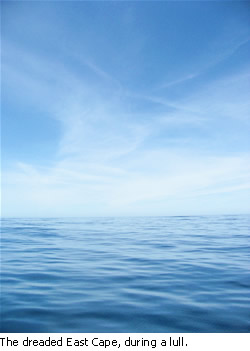
We’d picked our weather window carefully, and now we were here, at the dreaded East Cape. The sea was glassy, the weather calm. And instead of fighting for our lives, we could feed Free Willy from the palms of our hands.
But the problem with weather windows is that they come to a close. Sooner or later, the bastard reloads. We saw White Island at sunset, we spied the first dawn, and we frolicked with whales. And now we had a quandary. We could keep heading south toward Gisborne, arriving in the middle of the night. Or we could tuck into Tolaga Bay for the night and have a good sleep, then make for Gisborne in the morning. We opted for sleep, and the next day the window was closed.
 It wasn’t a gale, and there weren’t any mountainous seas. It was just twenty-five knots, on the nose, and six-foot swells, all the way to Gisborne. Sereia leapt and crashed, Silas hollered, and Peter tried to distract him with wolf noises below. I stayed on deck, dripping with spray, and tried to keep down my breakfast.
As for Matt, he just steered. He loved it. For about eight hours—though I admit I lost count—he wrestled that helm on course, steering us back and forth through angry seas as we tacked our way south to Gisborne. He refused to give up the wheel, helming in a 25-knot headwind , wearing nothing but shorts and a windbreaker. It was all we could do to keep handing him granola bars, watching anxiously for signs of hypothermia.

Then, at seven o’clock in the evening, we made it. It took us ten hours to travel twenty-five miles, but we tucked into Gisborne marina, just steps from the sportsfishing club, where bacon double-cheeseburgers and cold draft beer could be had for the asking.
 “WHY are you sailing around New Zealand?” people ask us, and sometimes I have the same question myself. We’ve been cold and miserable. We shower infrequently, there’s mildew on the ceiling, and sometimes we wake up in the night, afraid.
But then, the window opens. We sail through a wilderness that most people can’t begin to imagine. The outlines are crisper, the colors are finer for the fear we surmounted to get here.
And I'll make sure we keep extra bread on board, and every few days, we'll toss off a slice for Tangaroa.


