Friday, January 29, 2010

Pounamu

When Europeans landed on the West Coast in 1846, they encountered unbelievably hostile terrain. The northwest edge of the South Island was made of dense jungle bush, stinking swamps, and torrential rivers. The coast was lashed with rain, bashed by the storms that came hurtling off the Tasman, and—as if that weren’t bad enough—the whole place was infested with biting flies. They also found a bunch of skinny Maori, who were hanging on by their fingernails for one reason only: greenstone. They traded for it, they fought over it, and when negotiations failed, they killed for it. And they used the greenstone to do the killing.

Pounamu, as the Maori call it, is known to geologists as nephrite, the native New Zealand jade. It is beautiful, it is hard, and it can be carved to a razor edge.

In the Hokitika Historical Museum, I overheard a conversation between two bird-like old ladies. They were admiring some greenstone mere, on display in a glass case.

“These really are lovely, aren’t they?” the first one murmured, and her friend made a little twittering noise in agreement. The designs at the base of the mere were intricate and skillful, with interlocking curves carved in a low relief.

Then they started reading the caption. “Oh,” they said. “Oh my. Oh. Oh. Oh my word.”

This had to be good. I leaned over their shoulders to see what they were reading:

THE OLD MAORI USED THE MERE FOR STRIKING AND THRUSTING. A FAVOURITE USE WAS TO DRIVE THE SHARP EDGE OF THE BLADE INTO THE THIN PART OF THE SKULL. THE EXPERTS WERE ABLE TO WRENCH THE SKULL OPEN BY A TURN OF THE WRIST AFTER THIS THRUST.

Essentially, the mere is a can opener for your brains. This comes as a surprise to most Europeans, but unlike these sweet old ladies, the first pakeha settlers didn’t learn about greenstone mere in a museum. They found out the other way.

But greenstone can be put to all sorts of peaceful uses as well. Like jewelry, for example. Many Maori still wear pendants made of greenstone, but mostly their culture is appropriated by white people on holiday. I decided to join in this happy tradition when we came across a studio in Hokitika that lets you carve your own greenstone.

“I need to make a necklace,” I announced to Peter. “It’s for our new baby girl. She’s going to be the first New Zealander in the family, and she needs to start her jewelry collection.”

Peter, who is accustomed to this kind of self-serving logic, agreed. So he got to spend the whole day babysitting, while I got to take the day off to play in an art studio. This may seem like a hard bargain, but as I keep reminding him, I am a sacred vessel. I need special attention. And jewels.

Also, a little talent in stone carving wouldn’t hurt. Carving pounamu is a lot harder than it looks. The first Maori, who had no metal tools, worked the stone with a combination of sand, water, and the kind of mind-bending patience that we’ve lost since the invention of channel surfing. I had a whole roomful of power tools, and a teacher to supervise me, and I still came up with a greenstone turd.

Possibly, my design was too complicated. After looking through the binder of traditional motifs (fern fronds, fish hooks, marijuana leaves), I settled on the manaia, which seemed a good choice for a baby. Said to protect against evil, the manaia usually depicts a being with the head of a bird, the body of a man, and the tail of a fish. This is not as disgusting as it sounds. They’re actually quite beautiful.


First, I worked out my design. Note the bulbous bulges. I was trying to make the figure look female, since we’re having a girl:


Next, I chose which part of the stone to carve. You have to look at it with a backlight, so you can check for faults:


Then came seven hours of grinding and polishing. This got a little boring. It would have been more fun with cable TV and a remote. Also, possibly an iPod. And a sandwich.


Finally, at the end of the day, the finished product! The… Cancerous Aardvark!


Those bulges were supposed to be a breast and a belly, rather than malignant tumors. But as the Maori discovered long ago, greenstone is hard.

Besides, an aardvark makes a good guardian, too. Those claws'll tear you right up. Just like a can opener.

Sunday, January 17, 2010

Exposure Therapy

People who suffer from irrational phobias cope with a host of unpleasant symptoms, such as heart palpitations, shortness of breath, and the fear that they’re going insane.

A few days ago, we drove into Invercargill. It was the first time we’d visited since escaping six months ago. And as soon as we got there, I started to choke.

“What the hell’s wrong with you?” asked Peter, steering our ancient van through familiar streets. “You sound like you’re coughing up a hairball.”

“I’m dying,” I told him. My left hand started picking chunks of flesh from my forearm. It felt strangely relaxing.

“Stop that,” Peter swatted my hand away. “You’re acting crazy. Let’s go get a burger.”

“Not crazy,” I corrected him. “Phobic. I have Inverphobia. It’s an irrational fear of the Asshole of the World.”

“Whatever.” He rolled his eyes, parking our van in front of the world’s most southerly Burger King. “We’re here now, so you’re getting exposure therapy. Let’s try to find something to like about Invercargill, instead of just bitching about what a depressing place it is.”

Peter’s so great. He knows exactly how to pull me out of a funk. And he was right. While visiting Invercargill, our mission was clear: we’d find things to like about the Asshole of the World.

First up: the media. The main Invercargill newspaper is called The Southland Times, and that day’s copy just happened to be lying on the counter while we ordered our lunch. As luck would have it, the headline was a heartwarming animal rescue story. SOLVENT POURED ON DOG, the cover read, with a big color picture of the dog. The dog was bald, his skin bright pink. This made him especially cute and soft-looking.

Next, we visited the Southland Museum. Now, the great thing about the Southland Museum is that a dinosaur lives there. It’s true. His name is Henry.

Henry looks sort of like a dried-up iguana, but he’s actually a tuatara, which is a kind of Mesozoic sphenodon that flourished about 200 million years ago. Henry’s not quite that old, but he was born at the end of the nineteenth century, which means he’s seen pretty much all of New Zealand’s European settlement. If he wasn’t around for the Treaty of Waitangi, he hatched soon after, and he’s borne witness to the end of the Land Wars, World Wars I and II, the great flu epidemic of 1918, and the world’s first votes for women. Now, he lives in a glass box in Invercargill. He spends a lot of time biting the other tuatara. Nobody's sure why.

There’s also some great art at the Southland Museum, such as this lampshade made out of a varnished blowfish:

Many people choose to mock the bedraggled citizens of New Zealand’s most southerly city, but that seems cruel. Instead, we chose to count them, like endangered birds. In a rigorously scientific enquiry, we defined three basic population groups for study. They are:

THE TEENAGE MUM (TM): This group is easy to spot. They are pushing baby carriages, and they’re too young to drink in the United States.

THE CRAZY SOUTHLAND MAN (CSM): Somewhat more elusive than the Teenage Mum, the Crazy Southland Man displays at a minimum three of the following characteristics:
• wild grey hair
• darting eyes
• sunken cheeks
• autolalia (talking to self)
• open container (likely containing solvents to pour on dog)
• gum boots
THE AIMLESS RUFFIAN (AR): The Aimless Ruffian is defined by the following: he or she would be quite happy to spend a happy afternoon inhaling solvents. In fact, he would consider it time well-spent.

During the course of a 48-hour observation period, Peter and I observed the following:
TEENAGE MUMS (TM)............................10
CRAZY SOUTHLAND MEN (CSM)......... 6
AIMLESS RUFFIANS (AR)...................... 65
There are a great number of important conclusions to be derived from this data, such as the likely fact that each Crazy Southland Man has mated with an average of 1.6 teenagers, impregnating each an average of 6.5 times, thereby producing a small army of Aimless Ruffians. Where, one might ask, do they get all the solvents? How much of it do they inhale, and how much do they pour on dogs? These questions go beyond the parameters of our initial study, but I’m considering applying for a grant.

Then, there’s the wild mushrooms. Sure, the Italians talk big about their truffles, and in the American Northwest folks pick chanterelles right off the forest floor. But how many of those so-called connoisseurs can harvest mushrooms from their living room carpet? My friend Melissa can. Last winter, she couldn’t afford enough coal to heat her home, so she only warmed the place up a couple of times a week. Her house was so poorly insulated, and the air was so cold and damp, that she grew a healthy crop of mushrooms right in the living room floor. Imagine that. Wild mushroom risotto, without even leaving the frigid damp of your own house. That’s the kind of life Invercargill can offer.

And without a doubt, the highlight of our trip was our visit to Alliance Freezing Works, a sort of Wal-Mart mega mall of sheep death. This is the local slaughterhouse, where they process four million sheep in a nine-month season. By “process,” I mean electrocute, kill, eviscerate, dismember, and shrink-wrap to feed the world.

This was an amazing experience, and not just because Peter had to wear a sexy beard net. We got to follow the whole operation, dodging sheep carcasses and doing our best not to slip in the gore. And here, at the heart of the slaughterhouse, I saw the philosophical core of Invercargill, the man who made our trip complete.

"This guy here's cutting the asshole off,” our tour guide told us, indicating an elderly man on the line. He was wielding a razor-sharp knife, and as each sheep carcass came past, he lopped off the asshole with a flick of his wrist. That’s 16,000 assholes in a 12-hour shift. This man sliced out the assholes of sheep, lodged deep in the Asshole of the World. Four million assholes, all in a nine-month season.

I caught the guy’s eye, and he gave me a wink. And that’s the best part about Invercargill. If you can have a laugh here, you’re doing all right.

Monday, January 4, 2010

Convergence


Peter and I recently attended the Convergence Festival, where we hoped to cavort with naked hippies and obtain enlightenment. Unfortunately, the only naked hippy there was me.

This happened accidentally, when the door to the composting toilet I was using unexpectedly swung open. Before I knew it, I was displaying my nakedness in all its pregnant glory, complete with fat pants around my ankles and a fistful of composting sawdust in my sweaty palm. When I finally slammed the door shut, I found someone had scrawled the words ALL THAT IS IS NOW on the wall, which means that I will be a fat pregnant lady with a handful of wood shavings in a porta-potty, again and again, forever. Which is one kind of enlightenment. I guess.

I like to think of hippies as nature-loving free spirits, but these hippies had a lot of rules. The Convergence Festival is GE-free, alcohol and drug free, dog-free, and meat-free. It is also, apparently, ejaculation-free. I learned this when I attended the Introduction to Tantra Workshop, at which the teacher informed us that he had not ejaculated for months, because the loss of his divine sex energy would drain his body of vital life energy. After he said this, there was a long pause in the sharing circle.

“Is that all ejaculations, or just the ones from intercourse?” asked one participant.

“All of them,” the teacher replied. “Including intimacy with yourself, and er… nocturnal emissions.”

More silence.

“Is that healthy?” asked one woman. “I mean, not just on an energetic level, but like, for your body?”

Apparently, it is very healthy, and keeps our teacher in a constant state of ecstatic bliss. This might explain why later on, when I was peeling back the layers of his psychic mask to reveal his true and God-like form, he contorted his face into a grimace of sexual climax. I felt a little icky, as though I’d caught a stranger having a wank outside my window, but the Convergence Festival is judgment-free, so I didn’t say anything.

It is not, however, spelling mistake-free. I noticed this when I was sneaking back to our van for a snack of illegal ham. The festival is decorated with a number of multi-colored and uplifting banners, saying very nice words like BLISS and DIVINE and EXTASY. Perhaps the seamstress was thinking about exhuming her execrable ex-husband to smear his body with excrement, and she just got carried away. But somebody should really tell her that ecstasy starts with “ec.” Like eco-friendly. And eczema.

Speaking of eco-friendly, we’re not. Silas is a Huggies man, which is our diaper brand of choice, despite the unpleasant fact that they take 500 years to biodegrade in a landfill. We flirted briefly with the idea of Elimination Communication, before deciding that we do enough laundry without letting our baby pee all over the floor. Besides, Silas is entitled. He’s going to save the planet.

As it turns out, Silas is a Crystal Child. The Auckland pediatrician may have diagnosed him as globally delayed and autistic, but that’s because he is a limited man who is stuck in third-dimensional consciousness. As a Crystal Child, Silas was born on the Sixth Dimension of Consciousness, with the potential to open up rapidly to the Ninth Dimensional level of Full Christ Consciousness, and then from there to the Thirteenth Dimension which represents Universal Consciousness.

Allow me to back up a little. We first learned of Silas’ gifts when he started a staring contest with one of the participants at the Convergence Festival. The man pushed back his dreadlocks and gave Peter a serious look. “Have you ever heard of the Crystal Children?” he asked. “I’m no expert, but I think you should look into it. That child is special.”

We knew that Silas was special, of course, in the sense of special homes, where people learn to live independently, eat special food, and pet the special kitty-cat. But when we left the festival, I raced to the Internet to learn more about the Crystal Children. And now, everything is clear.

Apparently, Crystal Children began appearing on the planet in the year 2000. As Celia Fenn says on her website, they are “extremely powerful children, whose main purpose is to take us to the next level in our evolution, and reveal to us our inner power and divinity.”

But wait, there’s more. “The first thing most people notice about Crystal Children is their eyes, large, penetrating, and wise beyond their years. Their eyes lock on and hypnotize you, while you realize your soul is being laid bare for the child to see.” This is what so confused the Auckland pediatrician. “His gaze is very intense, but it’s not a social gaze,” the doctor told us. “He doesn’t really smile at me.”

Clearly, this is because the doctor’s soul was being laid bare, and Silas didn’t like the guy’s limited, third-dimensional aura. In fact, Fenn explains, “It's no coincidence that as the number of Crystals are born, the number of diagnoses for autism is at a record high.” This is because the Crystals often wait until they are three or four years old to begin talking. And why do they wait, you may ask? Are they autistic? Dispraxic? Globally delayed? Dumb?

No. They’re telepathic. In the future, Fenn writes, “We won't rely so much upon the spoken or written word. Communication will be faster, more direct, and more honest, because it will be mind to mind.” And that’s why Silas doesn’t talk yet. He is far too evolved to rely on verbal communication. He is communicating, just on the sixth dimension. So if you can’t understand him, that’s your problem. You’re just not spiritually evolved.

Another way you can spot a Crystal Child is that they are fascinated with rocks. Now, Silas has always loved rocks, to the point where he used to sit in the parking lot, popping rocks into his mouth like gumdrops. I used to worry that the engine oil and other toxins on the gravel might have given him some kind of brain damage, but now I know: it’s just his sixth-dimensional Crystal energy manifesting.

As a Crystal Child, Silas represents the next step in our evolution as a human species. As Fenn writes, the Crystal Children “are the pointers for where humanity is headed... and it’s a good direction!” Silas, and other special children like him, “aren’t autistic. They’re AWE-tistic!”

On the other hand, as I recently learned in the porta-potty, ALL THAT IS IS NOW. So the possibility remains that my son might never speak, but just eat rocks, forever and ever, into infinity.

And as a Crystal Child, he’s pointing the way to where humanity is headed. So take heart. When you’re ready, you’ll be eating rocks too.

Tuesday, December 22, 2009

Knockdown

Peter looked to starboard, and he saw a wall of white. Is that a wave? It couldn’t be a wave.

He looked again, squinting into the darkness. He’d been at the helm for hours now, the wind and seas steadily growing as we sailed south through Cook Strait. At the start of the gale, he could see the rollers charging toward Sereia’s starboard quarter, and he cracked off to port, keeping his stern to the swells. But now everything was black. He could still hear the waves, rushing waterfalls hissing up behind him, until the gusts came. Then all he could hear was the wind.

Something white was rushing at Sereia in the darkness. He couldn’t judge how large it was, or how fast it was approaching. There was no reference in the blackness. Is that a wall of water? It can’t be water. It’s too big.


***

I’d started throwing up that morning. It wasn’t much—I was eating lightly, drinking lots of water to keep the nausea at bay. When the vomiting started, it was my watch, so I tried to be quick. I held my hair out of the way, retched, wiped my mouth, then turned back to the helm so we didn’t fall off course.

Toward the end of my watch, I started throwing up water. And then I got a little worried.

Once you can’t hold down water, you fall into a downward spiral. When your stomach is empty, you dry heave—your body racked with exhausting, unproductive spasms. As time passes, you get weaker and more dehydrated, which makes you sicker. It’s a very difficult cycle to reverse. The only thing that’s worked for me is taking tiny sips of water, or sucking on ice chips.

Later, I sat on deck, watching the horizon as I sipped from my sports bottle. We could still see the coast of the North Island—we weren’t yet into Cook Strait—but the wind was already picking up. The water was grey and choppy, topped with whitecaps. Occasionally, waves rushed up the lee side, and I jerked out of the way, not wanting to get too wet, too soon. Wet foulies are a misery. I retched, emptying my stomach again, then sat down heavily. A much larger wave raced up the port side, bigger and faster than the others, lifting me up and floating me. I dug my fingers into the netting, adrenaline momentarily drowning the seasickness.

“Well, okay,” I said, dryly. I glanced at Peter. I wanted to see if he was alarmed. He smiled thinly. We both knew that this was the beginning.

I stayed on deck for awhile after that, knowing that the wind and spray were keeping the sickness from overwhelming me. But I was soaking wet from the waist down, and the wind was getting stronger. My teeth started to chatter.

“I’m shaking,” I told Peter. “I’m just going to go down below to warm up.”

He looked at me, and that was the first time I saw fear. I didn’t come back on deck for two days.


***

Peter was at the helm for the knockdown.

When the gust hit, it ripped his mouth open. His cheeks pulled away from his teeth, his face blasted by salt spray. He stumbled backwards, still gripping the wheel. That’s the strongest wind I’ve ever felt, he realized. Then: we’re completely overpowered.

The gust knocked Sereia on her side. She struggled to right herself, pinned by her sails. Our double-reefed main is tiny. There’s practically no canvas up, and it’s still too much. The third reef is our storm trysail. I was saving that for hurricane-force winds.

She was still heeled hard over when Peter heard the breaking wave. He couldn’t see it in the darkness, but the sound told him it was bigger and faster than the others. He could hear it hissing as it curled, breaking behind Sereia. There was no way to dodge it. He turned the wheel slightly to port, and held on.

The wave crashed over his shoulder like a blast from a fire hose. He felt Sereia skid sideways across the white water. She leaned hard over, pausing as the lee side filled with ocean and her bulwarks dug in. Then she fell, the main boom skidding across the swells. And her sail went into the water.

The cabin top was submerged. White water tore back toward the helm on both sides, filling the cockpit like a bathtub. Peter felt his legs floating, the ocean up to his chest. He was swimming in the cockpit. We’re like Silas’ bathtub toy, he thought, like that little plastic tug boat that fills up with water, right before it sinks to the bottom of the bath. Silas loves to sink that boat.

He thought: There goes the engine. It’s never going to start now.

He thought: I wonder if we’ll come back up? If we take another wave now, that’s it.
There was a sucking sensation as the water churned out the gunnels. Gravity returned, and he scrambled for a foothold. Sereia stepped up, out of the sea. And she started to move again.


***


It was the stench of piss that made me think of steerage. At about twilight, the waves got so rough that I was tossed out of the quarterberth onto the floor, and I remembered Peter had told me that the steadiest place on the boat was low down, amidships. Clutching my green plastic bucket, I crawled forward, laying my head on the floorboards.

The cabin sole was cold and gritty, which felt nice against my skin. My head was near the through hull for the head, the stench of ammonia cutting through the sickness. My thoughts wandered to those poor European immigrants, thousands of them, who’d crossed the Atlantic to New York in steerage class. They must have been lying on the floor like this, too wretched to move, the smell of piss in the air, vomit in their clothes.

Silas was crying. I could hear that he was crying, but I couldn’t move. My face flushed, I lifted my head to puke again, just clear stomach juices now, nothing left to throw up. Over and over, I convulsed, then lay my head down, the sickness paused. Now, I felt the cold. My face was bathed in sweat; my body shaking.

Silas was screaming. Somehow, through the sickness, I heard my own voice. Get your ass up off the floor and go help that baby. You’re his mother.

I staggered to my feet, steadying myself on the galley sink as I heard Silas retch, then scream. He retched again. I got there, too late. He was red, frightened, sick. There was vomit down his front, across the blankets. “It’s OK,” I told him. “Mama here.”

I pulled his shirt off, tossing it to the cabin sole, clearing away the soiled blankets, grabbing at a towel to mop the mattress. Silas kept screaming. He retched again, spraying his undershirt, his new storybooks, the towel. “That’s good,” I soothed. “Good boy. You got it all up. Mama here.”

I took off his undershirt, leaving him in his shorts. He lay back, exhausted, his eyes dull. I curled him into me, then sat up, spitting bile into our last dry towel.

The cabin was dark. Dimly, I was aware that it was night, that we were sailing through a storm. Waves smashed on our heads like bomb blasts in the dark. Below decks, the sound was magnified. The cabin was the inside of a fiberglass drum, each wave a tooth-jarring crash that made me think of Sereia’s structural integrity. I thought about steel against steel, an inch of fiberglass pressed against the seething ocean.

Silas and I rolled back and forth in the seas, the stinking mattress scattered with toys and storybooks. I’ve got to get this baby into the lee side, I thought. I’ve got to get him pressed up against me where I can protect him with my body.

I sat up, my head swimming. I started sweeping toys to the bottom of the bed with one hand, grasping Silas with the other and using my legs to brace against the bulkhead. I fell into the port side, reaching down to pick one plastic teacup from the small of my back. I grabbed my baby and snuggled him into my core, wrapping my arms and knees around him. He did not protest. He burrowed into me like a frightened animal.

When it came, the crash was violent and loud. I heard steel screaming in the darkness. I felt us go over, pitch gently sideways. Water sprayed into the cabin, spattering our faces. My mind hurtled through the possibilities. Knocked down. Dismasted. No, I don’t hear any broken rigging, if the rigging was shredded I’d hear something terrible. Knocked down, I think. And then: Jesus Christ is Peter still on BOARD? What if the harness snapped? What if he’s not there?
Above our heads, through the moaning wind, I heard my husband’s voice: “I’M OKAY! WE’RE OKAY!”

He was on board. And I blessed him.

I held Silas close in the dark, my body shaking against his little head.


***

Someone else was on board that night as well. Marina Nijs was our crew, a Belgian go-go dancer who’d never sailed a day in her life. She’d hitchhiked three days to meet us in Gisborne, and she was waiting for us on the dock when we arrived. We were impressed, so we hired her.

Marina is from a small town in the center of Belgium. Before joining Sereia, she’d been to the beach a few times, but she doesn’t like to swim unless she can see the bottom, because she’s “a bit wary about the animals.” She’s never surfed. She’s never been pushed down by the ocean. The closest she’s come to big waves is watching old surfing movies on DVD.

I asked her, later, if she’d ever been in a storm.

“Yes,” she said, “I’ve seen thunderstorms, in Belgium.”

“Have you ever been outside in one?”

“Oh, yes!” she nodded. “I love to watch them. Sometimes I open the window or the door, and I watch from the doorway.”

Throughout the storm, Marina conducted herself like a hero. And later, she said it herself: that was because she didn’t have the faintest idea what was going on.


***


Peter did the math in his head. It looked as though Sereia wasn’t going to sink. She was moving again, still on course for Lyttleton. The winds and the seas were huge, but the cockpit was dry, and he could stand again. How long is this going to last? He tried to remember the forecast. The winds weren’t supposed to lie down until the next afternoon, which meant he’d have to helm alone, through the storm, for another twelve hours at least. After the knockdown, there was no way he’d see any of his crew again. They’d be crouching down below, probably terrified. He hoped no one was injured.

The companionway hatch slid back, and Marina popped her head on deck.

Peter blinked. He couldn’t believe his eyes. “You’re brave,” was all he could say.

Marina looked confused. “What do you mean? It’s my watch, right? Ahh,” she conceded. “Yes. It’s very bad down below. Pots and pans go wizzing above my head!”

Yup. That’d be the knockdown, thought Peter. He assumed she knew what had happened.

“Oh, I almost forgot to tell you!” Marina went on. “There is water in the boat!”

Peter swallowed. This was the nightmare. The leak that a captain can’t find, the water that keeps rising until he can’t bail fast enough. “I think you’d better take the helm, if you can,” he shouted over the wind. “I have to check that out.”


***

Sereia has four bilge pumps on board, and that night, one by one, they started to fail. When he got down below, Peter looked first into the head, where Marina had seen the water. There was ocean sloshing around, three inches above the floorboards.

It hadn’t spilled into the main cabin yet, but Peter knows Sereia’s shape like that of his own body. If it’s above the floorboards in the head, that means the bilges are full. Sereia’s bilges are maybe three feet deep. How much water was that? Seventy-five gallons? A hundred? At eight pounds a gallon, that meant nearly a thousand pounds of dead weight, sloshing around in the boat.

He opened the floorboards. Peter, you cheap bastard. The primary bilge pump, the one that’s supposed to go off automatically, was broken. He’d known that before we left Napier, but the repair kit he’d found had been so wildly overpriced that he’d refused to buy it. I’ve got three other bilge pumps, he’d reasoned. That’s plenty.

Only, they weren’t enough. Now, he could see why. When he lifted up the floorboards, Peter saw black ocean, glinting in the light of his head lamp. Water had risen all the way up to the engine. The bilges were completely full. And the secondary bilge pump was only working intermittently, because some genius had installed it so that it only sucked water when the bilges were just about to overflow. With each wave, water flowed over the pump, and it sucked once or twice. Then, the water sloshed back the other way, and the pump just sat there, silent and useless.

On to the third bilge pump. This one was mounted on deck, and Peter would have to open up a panel in the cockpit to get to it. He grabbed a screwdriver and crashed on deck. Marina was still at the helm, a dim shape in the darkness. He couldn’t think about her now. He had to get the water out of the boat.

The problem with this pump was that it was potentially dangerous. When he opened up the panel to access it, Peter would be creating an six-inch hole in the deck. If we took another wave while that hole was open, or if we got knocked down again, the boat would take on more water. Maybe this time, it would be too much.

But he didn’t have a choice. At least, it’s on the windward side. We’ll be okay. He jammed his screwdriver in the fittings, twisting the panel open. He’d completely rebuilt this bilge pump just a couple of weeks ago. He knew it worked perfectly. He knew exactly where the handle was stored. He reached into the hole and fitted it into the slot.

One arm wedged in the bimini frame, braced against the crashing seas, Peter started to pump. Instead of water, he heard the unmistakable sound of sucking air. “This is bullshit,” he muttered. "I JUST rebuilt this fucking thing. I KNOW it works."

But it didn’t. He’d have to go to his fourth bilge pump, now. And if that one didn’t work, it would be buckets. He didn’t want to think about that.

Quickly, before another wave could come, he closed the circular panel. He unhooked his life harness and crawled to the leeward side, snapping in again on the port side jackline. This bilge pump, the last one, was stored in the port lazarette. When he opened the locker, there would be a four foot-square hole in the deck, just inches from the sea. Before the passage, he’d moved the pump to the top of the locker. He knew exactly where it was. But if we got knocked down while that lazarette was open, we would take on a catastrophic amount of water. It could sink the boat.

Working fast, he unlatched the locker and snapped open the lazarette. Reaching down into the hold, he put his hands on the bilge pump, hoisting it up and jamming it down into the cockpit well. He slammed the locker shut and turned his head to starboard, just as a breaking wave came over the windward side.

“Damnit, Marina, we’re trying to keep water OUT of the boat!” he hollered.

“I’m sorry! Talk to the water gods!” She grinned at him, her hood plastered against her face in the driving wind. Later, she told me how glad she was that Peter was still telling jokes.


***

When boats are lost at sea, it’s usually not because one thing went wrong. Every now and then, there’s a whale attack, or a someone falls asleep and hits a reef, but usually disaster comes from a combination of factors. Sailors call this the “cascade effect.” A boat is a complex system of interconnected functions, and when something goes wrong, it often means that another system fails as well. If you have enough equipment, enough crew, and enough knowledge, you can usually compensate, and everyone makes it out safely. It’s only when the cascade accelerates beyond your ability to keep up that you get into serious trouble.

Peter slammed his last bilge pump onto the cabin sole, ripped open the floorboards and inserted the hose into the sloshing pool of black water. He ran the other hose on deck, securing it to the stern rail so it would drain overboard. And then he reached for the handle, which he’d carefully lashed to the pump before the passage.

The handle wasn’t there.

This is it, he thought. This is the cascade. If I can’t get this bilge pump to work, then it’s buckets. If we’ve got a leak or a failed through hull, there’s no way we’re keeping up with buckets. Then, we get out the liferaft.

He heard a giant wave crash on deck, dumping another fifty gallons of water into the cockpit. And he had an idea. He went for his biggest screwdriver.

Peter’s got a screwdriver that’s at least a foot long, with a head about as wide as a man’s thumb. He pulled his tool bag out of the main cabin, trying not to smell the stench of vomit on the crumpled towels and blankets, trying not to think about the dark shapes of his wife and baby, pressed against the leeward side.

He grabbed the screwdriver and jammed it into the fitting, pumping so hard he thought for an instant he might snap the thing two. There was resistance. He knew he was pumping water now, but he couldn’t tell if the level was going down. A hundred pumps. Two hundred. It was much less efficient, pumping with the screwdriver. He knew he was only moving about half the water he could have pumped with the handle. As he worked, he calculated. There’s two buckets down here, the rubbish bin and the one we use for washing dishes. First, get the liferaft on deck. Secure it to the binnacle and toss it overboard, pulling the rip cord to inflate it. Send out a Mayday on the VHF. Set off the EPIRB. Get Antonia on the helm, tie her on if we have to. I’ll start bailing, then hand the bucket to Marina so she can pour the water overboard. Three hundred pumps. The water was going down. He pumped a few more times. It was definitely lower now. There wasn’t any leak.

Now, he had to relieve Marina. She’d been up there too long, she was probably freezing by now. He grabbed a muesli bar and drank some water. He popped his head up.

He couldn’t believe how much louder it was on deck. The wind was still screaming through the rigging, the deck pitching up as the waves lifted Sereia’s stern, then crashed to port in a surge of white water. Marina’s brow was furrowed, her face a mask of concentration.

“How you doing?” he yelled.

She answered him, but her wind whipped away her words. Peter gestured to her that he’d take over, and she crawled forward, unhooking her life harness when she got to the companionway.

Peter stood at the helm. The night was still black, though it had to be nearly dawn by now. He felt strong. Sereia had made it through the knockdown. He’d gotten the water out of the boat. This storm couldn’t last forever. We were going to make it.

When the second knockdown came, there wasn’t any gust. It was just a massive wave, breaking on Sereia’s stern. Peter never saw it. He heard it coming fast, like the rumbling of a giant waterfall, rushing up Sereia’s starboard quarter. There was nothing he could do.

Then it was blasting him, ocean white water cascading over his head. Sereia slid horizontally. Fuck, we’re going over again, he thought. Then: That’s too much water. This time, we’ll roll.

But she didn’t roll. Sereia slammed down this time, her mainsail hitting the water. But she wasn’t pinned, for those sickening few seconds. This time, she popped back up. The cockpit well was full, but it drained fast. Peter smiled. He knew it would.


***

Dawn did break, finally. Marina was on watch when the sun came up, and she could see the waves for the first time. “It was a bit… unsettling,” she told me. “They were above me. I think they were above the bimini. They were black. Not the normal color of the sea at all.”

Peter came in to the cabin, that morning, to see if Silas and I needed anything. I asked for some water. “I can’t look at you,” he said to Silas. His voice sounded unsteady. “I ‘m afraid I’ll cry.”

“What was that noise?” I asked. “The big one. The really big one.”

“We got knocked down, baby,” he said. “Twice.”

Then he went on deck. I realized, then, how serious it was. How horrifying it might have been. I held Silas close, tears sliding into his hair.


***

We made it to Lyttleton on the third night, then stood off the coast until daybreak. When it was light enough to see, Peter steered us into the harbour and dropped the hook.

Neither Silas nor I had held down any food or water for two days. When I got out of bed, I was shocked to see myself in the mirror. My stomach was flat. It looked like I wasn’t pregnant anymore.

The cabin sole was a foot deep in sodden possessions. Clothing, towels, books and saucepans lay in heaps of salt-soaked debris. We’d need a shovel to clear it all away.

Marina was cold and wet, but exhilarated. She came to get Silas, to give him a big hug and change his diaper. Silas loves Marina, but he screamed when she touched him. He was terrified to be out of my sight.

At first, she couldn’t find the diapers. We usually keep them in the quarterberth, aft on the starboard side. When she finally found them, they were all the way forward, hidden under the dining table. They’d flown to the opposite side of the boat.

We sat in the cockpit, drinking tea and talking about what had happened.


Peter was particularly perplexed by water I’d felt, spraying into the main cabin. The windows were all intact, so a leak didn’t make sense. Then he smacked his forehead. “Of course. It’s so obvious. The dorade.”

I blinked. “The dorade?” Dorades are periscope-shaped fittings on deck, specially designed to let cool breezes in down below, while keeping out water and spray. There’s no way the fitting could have leaked, unless it was submerged.

Still, that was the only way we could have felt the spray. We measured the dorade’s position from Sereia’s port side. It’s three feet in. During the knockdown, Sereia had a third of her beam underwater.

I wrapped my hands around my cup of tea, warming my fingers. “I’m amazed no one’s hurt. And the rig’s okay?”

“It looks fine. I’ll have to do a complete check, but it looks like all we lost was a bucket over the side.”

Peter raised his mug to Marina. “Excellent helming. There’s not many crew would come right back on deck after a knockdown like that. That was very brave.”

“After a what?” asked Marina. “What’s a knockdown?”

She had no idea what had happened. So we told her.


POSTSCRIPT:

After a great deal of thought and discussion, we've decided to put this sailing trip on hold. The Southern Ocean is a place for experienced, adult sailors— it's not for little babies, and it's not for women who are nearly five months pregnant.

We've purchased a beat-up van to continue our exploring New Zealand by land. Stay tuned for Sereia's ongoing adventures... this time by gypsy caravan!

Sunday, December 13, 2009

Arrived Safe

Knocked down twice in Cook Strait. Arrived Lyttleton. Everyone safe. More later.

Monday, December 7, 2009

Cliff-Diving

My father used to hang glide when I was a kid. He told me the best hang glider was the guy who got up at five o’clock in the morning, packed up his gear on the roof of his car, made himself a bag lunch, and then poked his nose outside. If the wind didn’t feel right, he didn’t go. He made other plans for the day, no matter how much he’d been looking forward to jumping off a cliff.

Then my Dad broke his arm and stopped hang gliding. He took up safer hobbies, like windsurfing and eating smelly French cheeses. This may have something to do with being a responsible parent. I can’t be sure, because I never really listened to that part of the lesson. Sailing our baby down the Wairarapa Coast is not the safest way we could be spending our time. We could be home right now, on land, watching Finding Nemo for the eight thousandth time while Silas learns how to take off his diaper and fingerpaints the walls.

The part of my Dad’s lecture I did listen to, though, was the bit about turning around if the wind didn’t feel right. We’ve been watching the weather for days now, planning our next hop to the South Island. This is easily the most challenging leg of our journey so far. It’s about 360 nautical miles to Akaroa, our destination. Most of the trip is in the Roaring Forties. In order to get there, we have to sail through some of the stormiest waters on New Zealand’s East Coast, then cross the Cook Strait, where winds can funnel through the narrow pass and kick up massive seas. The trip will take us three to four days, and there’s no safe refuge between Napier and Akaroa. Once we leave, we’re committed. We either keep going , or we turn around. There’s no third option. We could head out to sea, but the next stop would be Chile.

We knew this leg would be hairy, and we’re ready for it. We met up with a carpenter here in Napier, and had him make us a set of washboards instead of the cute little doors that usually cover Sereia’s companionway. He also made a set of 1-1/2” kauri battens for our doghouse windows, bolted right through the cabin. Our windows are now at least twice as strong as they were before, much less likely to shatter in case of a knockdown.


Peter’s been stalking the web for weather like most men search for online porn. He has to keep at it, because the really tricky part about the weather down here is that it changes all the time. On Friday, we thought Sunday would be a good day to leave. On Saturday, our window moved to Tuesday. Yesterday, we saw a front building, but we figured if we left this morning, we might squeak past Cook Strait before the really nasty weather hit. Then today, the forecast changed again:

Outlook following 3 days: Northeast rising to Tuesday afternoon 20 knots. Becoming Tuesday evening northwest 20 knots, rising Wednesday afternoon 35 knots and Thursday 50 knots with high sea.

It’s those last 6 words that got me. Fifty knots? Fifty knots?? The Wairarapa Coast is a notorious place. Land people say, “Don’t go,” but they say that about everything interesting. We ignore them. We listen to the fishermen and the delivery captains, the guys who’ve been there. “Wouldn’t want to be down the Wairarapa in a blow,” they tell us, looking grim. “You’ll want a northerly wind, not a northwesterly if you can help it. And stay away from those southerly blows. They’ll stop you dead.”

Yesterday evening, we tried to keep things light. “Fifty knots, ha ha,” we tittered. “At least it’s going in the right direction. Who knows? We might miss it completely!”

Then I woke up in the night, electrified with fear. I stared at the water reflections wavering on the cabin wall. It’s not Sereia I’m worried about. She can take fifty knots. We wouldn’t sink. At least, I don’t think we’d sink. But what about Silas? What if he gets sick, not just for a few hours, but for days? What if I get so incapacitated that I can’t move or function? What if we make it through two days of hell, only to get turned around?

This morning I went to take a shower, hoping to collect myself. Peter rang up John, the guy who made our washboards. He’s delivered boats all over New Zealand. He lives in Napier, and these are his home waters. As expected, he didn’t tell us not to go. Instead, he said, “If you go today, and it blows fifty when you hit the Strait, you will be very, very uncomfortable.”

John’s version of “uncomfortable” is most people’s version of “car crash.” He confirmed what Peter was already thinking.

I came out of the shower, still shaky. I’d surprised myself by bursting into tears while I was putting on my shoe. I stood there, in the shower stall, wearing one shoe, my breath coming hot and fast. I wasn’t sad—not at all. I was scared.

“It’s not a good idea,” Peter said, as we sat on the ground to talk. “If we go today, we’re going to get our asses handed to us. If it was just you and me, and you weren’t pregnant, we’d take a shot of rum and we’d just go for it. It would be fun—”

“But what if we don’t get our weather? What if we get stuck and we run out of time?”

The question hung in the air, unanswered. Because that’s always the question. People do get stopped in New Zealand, all the time. They get tired of waiting and then they make plane reservations. Or else they sail into a storm, and battle it out. Mostly, they make it. Sometimes they don’t.

“It’s still early in the season,” Peter soothed, rubbing my back. “We might go tomorrow. You never know.”

But today, at least, the wind wasn’t right to jump off a cliff.

Friday, December 4, 2009

Give The People What They Want

Napier is known as the Art Deco City, because the whole place was rebuilt in the 1930’s, when people thought Art Deco was neat because it reminded them of primitive savages and shiny new cars. They were looking for a cheerful sort of architecture, something to make them look to the future. That’s because on a bright sunny morning in 1931, their city disappeared.

The first thing that happened was that the ocean went away. Ruth Park, one of the survivors, was out in a rowboat with her dog at the time. "On a still hot morning, February 3, an extraordinary phenomenon occurred. The tide went out and didn't come in... The sea did not roll up like a scroll, like the sky in Revelations. It quietly withdrew.*"

Then the earthquake hit. It’s hard to imagine a 7.8 earthquake, even if you’ve lived through a few quiet tremors in your life. Since the Richter scale is logarithmic rather than linear, an increase of one point indicates a shaking increase of one thousand percent. The 1989 Loma-Prieta earthquake in San Francisco, for example, measured 7.0 on the Richter scale. It made the Bay Bridge collapse. And the 1931 earthquake in Napier was nearly ten times worse.

The Napier earthquake also happened more than half a century earlier, so the city wasn’t prepared with modern emergency procedures. The nurses’ home near the main public hospital collapsed, crushing much of the city’s medical staff. And when the first fires broke out, firefighters discovered that the earthquake had shattered the waterpipes. The hydrants were dry. Citizens who weren’t already buried in rubble ran from the ruined town. By nightfall, more than a hundred fires blazed. The city burned for thirty hours. Audrey McKelvie lived through the quake, and as she put it, “It wasn’t just a disaster. It was the death of a city.**”

But disasters make great tourist attractions, especially once the city’s been rebuilt and the people have had a chance to recover. Storefronts are painted in the colors of fruit-flavored sorbet, and the street names are laid out in charming mosaics. There’s a downtown bank that incorporates Maori spirals in its façade and ceiling, New Zealand’s own version of the noble savage design motif. Since the red and black rafter patterns in Maori meeting houses are heavily symbolic, depicting local geneaologies and wildlife sacred to the tribe, I had to wonder what the design on the bank’s ceiling represents. Old-time bank presidents? The sacred principle of compound interest?

The city’s done a great job encouraging Art Deco as a massive tourist attraction. There’s an annual Art Deco festival, the city’s been nominated for Unesco World Heritage status, and there’s even a McDeco McDonald’s in town. If a new business puts up a sign and it looks Deco enough, the city council kicks down a check for $500. If someone puts up a building in a contrasting design—Bauhaus, say, or Tudor Revival—it’s possible the city will burn it down. No one will admit to this, but I have my suspicions.

And yet, despite all the city’s best efforts, Art Deco is not Napier’s greatest treasure. The town center is nice enough—I like pink buildings as much as the next girl. But all that cheerful architecture pales in comparison to Napier’s true gem, the jewel in her crown. I refer, of course, to Opossum World.

Opossum World is a treasure-trove of knowledge. A combination storefront-museum, Opossum World educates its customers about the Brushtail Opossum, an Australian marsupial that was introduced to New Zealand in the nineteenth century, with devastating results. The Australian opossums loved New Zealand so much that they immediately started making babies and eating their way through the native bush. They’ve destroyed millions of native trees, from pohutukawa to rata, and they’ve endangered several species of native birds: kokako, kereru, and even the best-loved kiwi.

Luckily for New Zealand, the opossum also has a marvelously soft and snuggly coat, and when mixed with merino wool, it provides fur for sweaters that sell for hundreds of dollars each, as well as slippers, socks, and the indispensible Possum Peter Heater, which warms more crucial parts of the body. So killing possums not only protects the environment, it also results in a very profitable export trade.

I offer the above as background knowledge only. What makes Opossum World spectacular has nothing to do with sweaters and native birds. Really, it’s all about the displays.

Opossum World is quite likely the only place on earth where you can see a fully annotated exhibit of all the different ways to kill opossums. There’s the Timms Trap, in which “the opossum triggers the mechanism which compresses the arteries to the brain,” and the enticingly named “Gin Trap,” now sadly illegal. There’s the Victor Coil Spring, the Victor Soft Catch, and the good old-fashioned cage, as well as my favorite label, which reads simply: THIS OPOSSUM WAS KILLED BY CYANIDE.

And that’s not all. Where else, I challenge you, can you pay a dollar to shoot at already-dead opossums that someone’s tied to a tree? Or push a button and see five poorly-stuffed marsupials singing “On the Road Again,” perched cheerfully on the roof of a Morris Mini automobile?

There’s an exhaustive display on the possum lifecycle, showing opossums at each stage of their reproductive life, from kitten to crusty old age. It features a sort of explicit opossum porn, in which the female licks her belly so the tiny opossum fetus can wiggle, worm-like, from her birth canal to her pouch. These opossums, I should note, were killed and stuffed around the time of the Napier earthquake. They look like desiccated muppets from beyond the grave, their ears as crispy as potato chips. It was unspeakable. It was marvelous. I could not tear my eyes away.

And there, at the center of the case, lay the pièce de resistance, the cornerstone of the museum’s collection: a pickled opossum fetus in a jar. Skinny and translucent, it looked like a genetic experiment gone horribly wrong.


I tried to buy it as a souvenir. I begged the woman at the front desk to sell it to me. But she was immovable. She’d sell me a sweater or a sock, or even a Possum Peter Heater, but the pickled opossum fetus was not for sale.

That’s my only problem with Napier. It’s a charming town, but they just don’t understand what people want.

____________________________________________________
* Bob Brockie (ed.), The Penguin Eyewitness History of New Zealand. Auckland: Penguin Books Ltd., 2002. (pp. 158-9)

** Gaylene Preston, Survivors' Stories. Gaylene Preston Productions, 1998.

Wednesday, November 25, 2009

Window

I’ve never had to dart across the street under fire, but I’ve seen people do it on TV. The trick is to crouch behind something thick and bullet-proof—a shot-up car, for example, or a buxom young blonde. You squat there, looking intense, then poke your head out like an anxious groundhog. When the coast is clear, you make a break for it, charging across the street before the bastards get a chance to reload. That’s the basic set-up, though you can accessorize with a sawed-off shotgun or a steel briefcase full of money if you prefer. QKNW6BDWDSBP

Apart from the briefcase full of money, that scenario is a lot like sailing around New Zealand. Before rounding East Cape, we crouched in Mt. Maunganui, feeling nervous and forlorn. Every morning, Peter checked the weather. “GALE WARNING IN EFFECT,” the friendly lady informed us. “WINDS SOUTHWEST 20 KNOTS, RISING TO 40 KNOTS IN THE AFTERNOON. MODERATELY ROUGH SEAS BECOMING VERY ROUGH IN THE AFTERNOON. IF YOU SAIL TODAY, YOU’LL DROWN, WHICH IS AN EXTREMELY PAINFUL WAY TO DIE. THANK YOU FOR USING NEW ZEALAND MET SERVICES.”

“Maybe we should wait a day,” Peter would suggest. “That Turkish place makes an awfully good falafel.”

Then we’d go into town and stuff ourselves with chickpeas and chili sauce, and try to forget the Apocalypse that was being unleashed to the east of us.

And then, last Friday, we got our weather window. “WINDS NORTHWEST FIFTEEN TO TWENTY KNOTS,” the friendly lady informed us. “CHANGING TO WEST TWENTY KNOTS THIS EVENING. SEAS CALM. IF YOU SAIL TODAY YOU WON’T DROWN, THOUGH YOUR BABY MIGHT THROW UP ON YOU IN A FOLLOWING SEA.”

“Let’s do it!” Peter announced. “Get that anchor up and roll out the towels. We’re headed to Gisborne!”

And despite the weather lady’s friendly optimism, we took every precaution. The first thing we did was move three hundred pounds of chain out of the bow, and shift it into the bilge. This, we hoped, would help Sereia to sail through waves, rather than just squat on them like a petulant toad. Then, I prepared to be demolished by seasickness. I made a pile of ham sandwiches, a big pot of pork and beans, and baked several loaves of bread.

As we steamed out of Tauranga harbour, we clutched our bread at the ready. There’s a statue of Tangaroa there, the Maori god of the sea. As you leave port, you say a little prayer and toss him some bread—or else. In 1950, the crew of the Ranui got a little drunk and chucked some empty beer bottles at Tangaroa, instead of his favorite food. Their boat smashed on the rocks, and twenty-two sailors were killed. Sereia wasn’t about to make the same mistake.


Peter and Matt raised the sails and headed out to sea. Silas sat down below, happily playing with Legos in our cabin. And I lay down my head and prepared to die. It’s only forty-eight hours, I reasoned. A person can throw up for two days and survive. How bad can it be?

And it wasn’t so bad, actually. Like so many worries and fears, the anticipation was worse than the trip. Our sail round East Cape, in fact, was fabulous.

First, we sailed North-Northeast, directly for White Island. White Island is an active volcano which last erupted in 2000, shooting boulders the size of Buicks into the surrounding sea. We approached it at dusk, when the sun set its slopes in sharp relief. Pale puffs of smoke shot above the cliffs, the crater’s rim curling like the claws of a crab.


Enraptured, I took my hands off the wheel. And promptly jibed the boat.

“Sorry sorry sorry!” I hollered, yanking us back on course. Jibing the boat by accident is a major faux pas in the sailing world, sort of like throwing up on yourself at an afternoon tea party. But Peter barely noticed. Because right then, a seagull the size of a Labrador retriever swooped past.

“Holy shit, was that an albatross?” Peter ran to the stern, pointing like a maniac. The bird, now headed toward the volcano, had an obscenely wide wingspan. You would have a difficult time parking this bird in a single-car garage.

We left White Island astern, its smoke signals floating in the gathering gloom. That night, as we approached East Cape, the wind kicked up and we sailed all night, charging toward the easternmost point of New Zealand in a rush of waves and foam.

Because I am a selfish troll, I claimed the last night watch, and sailed into the dawn on the morning of November 21st. I saw the sky blushing pink behind the Cape, and tried very hard to feel awe-struck at the thought that I was the first human being to see the morning. But irritating, rational thoughts kept invading my head, like the notion that the Earth is a sphere, and time zones are arbitrary lines drawn on a map. So I just sat there, shut up, and tried not to jibe the boat.

The island off the coast of East Cape, by the way, is called East Island, which almost makes a complete set: North Island, South Island, and East Island. Those early New Zealanders had a marvelous knack for metaphor.

Late that morning, I was sacked out in the main cabin, when Peter gently tugged my shoulder. “Orca,” he whispered. “A whole family of them. Come and see.”


I dragged myself on deck, and there they were. At first, they looked like dolphins, just fins breaking the surface of the water. Then they swam right at the boat, peeking at our propeller and rising to the surface to see who we were. A family of orca: mama, papa and a little baby.
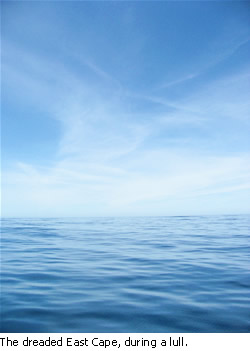
We’d picked our weather window carefully, and now we were here, at the dreaded East Cape. The sea was glassy, the weather calm. And instead of fighting for our lives, we could feed Free Willy from the palms of our hands.

But the problem with weather windows is that they come to a close. Sooner or later, the bastard reloads. We saw White Island at sunset, we spied the first dawn, and we frolicked with whales. And now we had a quandary. We could keep heading south toward Gisborne, arriving in the middle of the night. Or we could tuck into Tolaga Bay for the night and have a good sleep, then make for Gisborne in the morning. We opted for sleep, and the next day the window was closed.

It wasn’t a gale, and there weren’t any mountainous seas. It was just twenty-five knots, on the nose, and six-foot swells, all the way to Gisborne. Sereia leapt and crashed, Silas hollered, and Peter tried to distract him with wolf noises below. I stayed on deck, dripping with spray, and tried to keep down my breakfast.

As for Matt, he just steered. He loved it. For about eight hours—though I admit I lost count—he wrestled that helm on course, steering us back and forth through angry seas as we tacked our way south to Gisborne. He refused to give up the wheel, helming in a 25-knot headwind , wearing nothing but shorts and a windbreaker. It was all we could do to keep handing him granola bars, watching anxiously for signs of hypothermia.


Then, at seven o’clock in the evening, we made it. It took us ten hours to travel twenty-five miles, but we tucked into Gisborne marina, just steps from the sportsfishing club, where bacon double-cheeseburgers and cold draft beer could be had for the asking.

“WHY are you sailing around New Zealand?” people ask us, and sometimes I have the same question myself. We’ve been cold and miserable. We shower infrequently, there’s mildew on the ceiling, and sometimes we wake up in the night, afraid.

But then, the window opens. We sail through a wilderness that most people can’t begin to imagine. The outlines are crisper, the colors are finer for the fear we surmounted to get here.

And I'll make sure we keep extra bread on board, and every few days, we'll toss off a slice for Tangaroa.

Wednesday, November 18, 2009

Renewable Energy

When you start your day coated in vomit, you know things can only get better. This was a comforting thought for me, as I pushed aside a foul-smelling baby and heaved mightily into a red plastic bucket.

“Oooooh,” said Silas, impressed at the volume.

“Sit back and observe, youngster,” I told him. “You’re learning from a pro.”

“Da DA!” Silas crowed, then lunged at the bucket. “Di di di di di !” He flapped his hands, hoping to splash in the nice warm sauce his mother had made. When I yanked it away, he looked at me inquisitively. Where’s my rubber ducky? he seemed to be asking. Where’s my toy boat?

“Cool it, kid,” I told him. “It’s five o’clock in the morning. We don’t splash in our vomit ‘till at least lunchtime.” At the thought of lunch, I heaved again, then handed the bucket up to the cockpit so I could set about cleaning up the mess.

Sereia can be a tough boat to sail on. Though the winds never got above twenty knots on this last leg to Tauranga, they were right in our face. The water was tossed with a short, steep chop, the sort of conditions that make Sereia jerk to a halt, like an angry horse bucking her bridle. There was no question of cooking bacon and eggs for the crew, or even a hot cup of coffee. It was all I could do to roll up our curdled linens, get out fresh clothes for Silas, and pour myself into my foulies so I could stagger out on deck.

Poor Peter, with his cast-iron stomach, entertained the seasick baby down below. I stood on deck, breathed deep, and tried to collect myself.

It’s amazing how seasickness will change your perspective on things. Rolling green hills become nightmarish cliffs of desolation and despair. A delicate pink sunrise looks tawdry and fake. I concentrated on the horizon, imagining a cool glass of ice water, and swallowed to push down the nausea.

“Do you want me to helm?” asked Matt, and after awhile I was grateful to give over the wheel.

Every boat should be powered by eighteen year-old. They are cheap, enthusiastic, and apparently indefatigable. Matt’s our latest crewmember, a high school swim athlete from Connecticut. He’s good-natured and easy-going, both crucial qualities on a small boat. Also, he has British parents, so he sounds like a world-weary aristocrat in a Henry James novel. This is very good for Sereia’s rep. It makes us look yachty.

He can also sail. While Peter read stories to Silas, and I lay like a wet washcloth on the deck, Matt took the wheel, helming for at least eight hours straight with nothing to sustain him but youth and a small bag of trail mix. Even after the waters calmed, even after everyone felt better and Silas could be left alone for a few minutes without fear of projectile milk vomit, Matt still wouldn’t relinquish the helm. Peter finally had to wrestle it away from him so he could pilot our boat into the tide-ripped entrance, and find us a safe place to anchor.


Now that we’re safely moored in the shadow of Mt. Maunganui, we’ve been coaxing Matt to stay with us. We discovered the farmer’s market, and began plying him with fresh strawberries and asparagus, hearth baked breads and local artisanal cheeses. He’s agreed to help out while we round East Cape, but after that, he says he’s got to go. He’s got some lame excuse about wanting to “travel” and “see the South Island.” I don’t know what it was exactly. I didn’t really listen.

And so we sit in Mt. Maunganui, waiting for our weather window to Gisborne and pondering East Cape. Our cruising handbook isn't helpful. The section for our next passage has a particularly shrill introduction:

"PASSAGES ROUND EAST CAPE SHOULD ONLY BE UNDERTAKEN BY WELL-FOUND YACHTS FULLY EQUIPPED TO OFFSHORE STANDARDS AND MANNED BY EXPERIENCED CREWS. TIDE RIP…OVERFALLS … DANGEROUSLY HEAVY SEAS.. THIS WHOLE AREA CAN BECOME EXTREMELY TURBULENT. .. HEAD WELL OUT TO SEA TO AVOID THIS TURBULENT AREA.”

“Why’d they have to write it in all caps?” Peter asks, looking up from our laptop in disgust. “They just write it like that to scare people.”

“Well, we’re a well-found yacht, fully equipped to offshore standards,” I counter. “We should be fine. And we have experienced crew.” I smile sweetly at Matt, heaping a little more French toast on his plate.

“Yeah,” Peter mutters. “Except for Silas.”

Except for Silas. And that’s what it comes to, always. When I wake in the night, fear squatting like a toad in my throat, I touch Peter’s hand and I know he’s awake too.

It’s not us. We’ll endure just about anything to cut through the ocean, feel the stars at our fingertips, sail a stiff breeze. It’s Silas, our little boy who cracks his head against bulkheads and cries when his milk comes up the wrong way. He doesn’t understand. We are fearful for him.

When we round East Cape, we hope to do so at dawn. Because of the way the world’s time zones are drawn, we might be the first people on Earth to see the morning. I’ll bring Silas on deck, and point out the rising sun.

If he’s not too sick, he might even enjoy it.


Then there's the fact that Silas enjoys poking Matt's face when he's asleep. Maybe this is why our crew feels the sudden urge to travel.